GovTech: Mark43 Launches Firearm Investigation Tool With ATF

By: Thad Rueter

gun

The newest offering from Mark43 provides a link between law enforcement agencies and federal authorities during investigations that involve guns.

The supplier of public safety technology says via its Crime Gun Data Interfaces, law enforcement agencies can connect record management systems with two systems operated by the Bureau of Alcohol, Tobacco, Firearms and Explosives, or ATF: the NIBIN Enforcement Support System and eTrace.

The offering automates submissions of data about firearms from the Mark43 RMS to ATF, according to a statement. That reduces manual entry, potentially speeding up investigations into gun-related crimes while adding more digital efficiency to the process.

Results could come in minutes or hours instead of days or weeks, Mark43 said.

The company conducts a “daily download” with the ATF that includes information about “new firearm manufacturers, firearm models, calibers and importers,” Adam Brewer, a former ATF officer who now works as Mark43 services and partner enablement lead, told Government Technology via email.

Brewer said the company built the new system with help from the Louisville Metro Police Department, and in response to customer demand from law enforcement agencies. In Louisville, the detection tool has reduced processing time by 95 percent, he said.

That department processes more than 3,500 guns each year.

“We were spending 10 to 14 days on manual, batch-based submissions, requiring follow-up reviews and lots of waiting,” said Kris Cambron, property room supervisor at LMPD, in the statement. “Now, with the Mark43 interfaces, that data can be sent instantly, enabling investigators to receive trace results in hours.”

This is not the first time a gov tech supplier has decided to get deeper into gun detection. In 2023, Axon, known mainly for its body cameras worn by police, launched a database for police-involved fatal shootings.

Original Story: https://www.govtech.com/biz/mark43-launches-firearm-investigation-tool-with-atf

Mark43 Delivers Connected, Real-Time Crime Gun Intelligence to Accelerate Investigations

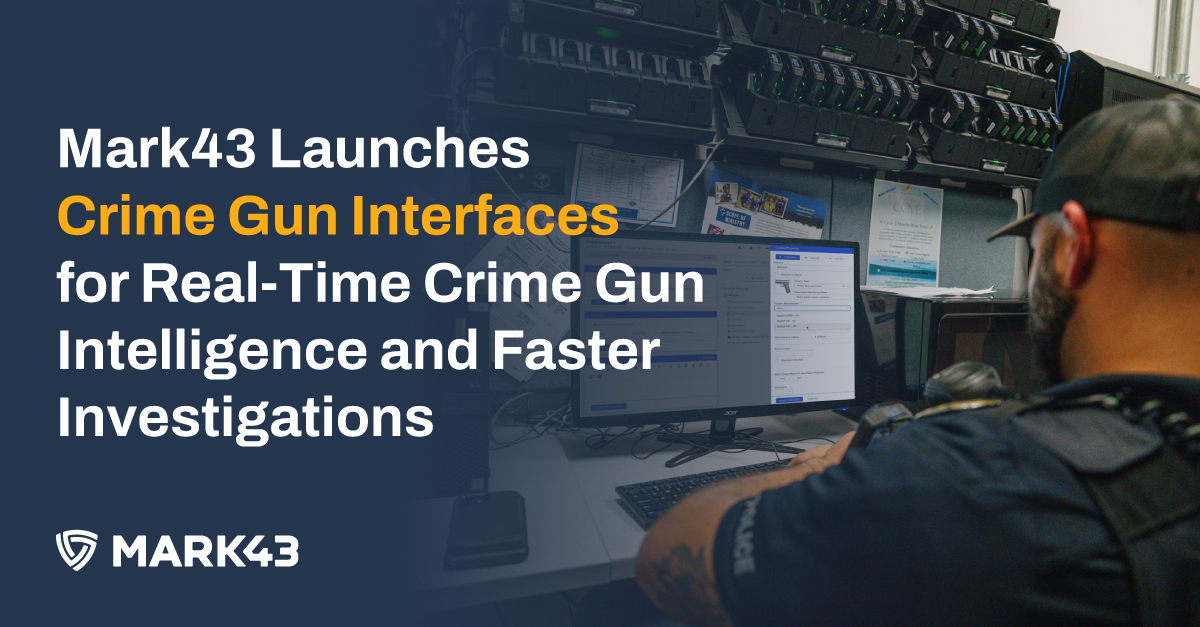
NEW YORK – June 25, 2026 – Mark43, the leading public safety operations platform, today announced the availability of its Crime Gun Data Interfaces, enabling agencies to connect its RMS with the Bureau of Alcohol, Tobacco, Firearms and Explosives’ (ATF) NIBIN Enforcement Support System (NESS) and eTrace systems. Developed with the Louisville Metro Police Department (LMPD), the interfaces automate agency-directed submissions of crime gun-related data from Mark43 RMS to ATF systems. By reducing manual entry, the interfaces help agencies submit more timely and complete crime gun data for analysis and access critical trace and ballistic intelligence in hours instead of weeks. 

For many public safety agencies, submitting this crime gun information to NESS and eTrace remains manual and fragmented. Staff often re-enter the same information across multiple systems, with submissions to NESS and eTrace taking up to 15 minutes and results delayed by days or weeks. For agencies already managing growing caseloads with limited staff, these inefficiencies make it harder to identify connections between shootings, firearms, and suspects, introducing errors and slowing investigations.  

The interfaces are designed to support agencies in accordance with their own policies, applicable laws, and existing investigative workflows. They help automate and improve processes that many law enforcement agencies already perform manually when working on crime gun investigations. 

“Our customers have come to us for years with the same problem: firearm data getting stuck. Captured in one system, manually re-entered into others, with critical intelligence delayed or missed entirely,” said Florian Mayr, Co-Founder and Head of RMS at Mark43. “By embedding submissions workflows directly into Mark43 RMS, agencies reduce manual entry and move crime gun data through the investigative process faster. The moment data is entered it can be shared, analyzed, and returned as actionable intelligence without the lag or duplication that has historically slowed investigations.”  

Using the NIBIN/NESS Interface and eTrace DIRECT Interface, agencies can: 

  • Capture firearm data, including make, model, and serial number, once and submit automatically, eliminating duplicate entry 
  • Receive trace results, including purchaser and possessor information and ballistic intelligence in hours rather than days 
  • Surface connections across firearm, forensic, and incident data to identify patterns and links faster, including automatic updates to the firearm code tables between Mark43 RMS and ATF 
  • Reduce errors and free staff to focus on active investigations 

The interfaces were developed in close partnership with LMPD, a long-standing Mark43 customer that helped define the vision and refine workflows. “This started with a real challenge and a shared commitment to solving it,” said Heidi Fieselmann, Director of Customer-Focused Solutions at Mark43. “By working closely with LMPD and in coordination with ATF, we built interfaces that get critical firearm intelligence into investigators’ hands faster, helping them act on leads sooner, strengthen cases, and ultimately bring justice for people who have been victimized.”  

“We were spending 10 to 14 days on manual, batch-based submissions, requiring follow-up reviews and lots of waiting,” said Kris Cambron, Property Room Supervisor at LMPD. “Now, with the Mark43 interfaces, that data can be sent instantly, enabling investigators to receive trace results in hours. Investigators now have immediate access to connected firearm, forensic, and incident data, supporting faster, more definitive investigations.” 

At LMPD, the results have been significant. Processing more than 3,500 firearms annually, the automation has delivered notable operational impact. LMPD has achieved an average 95% reduction in cycle time, reducing turnaround to as little as six hours. This translates to more than 3,500 staff hours per year saved and an estimated $157,500 in labor cost savings annually. 

“The biggest outcome is the availability of information and the speed at which it comes back,” Cambron added. “Investigators now have forensic details, trace history, and case information all in one place, which helps support gun crime investigations more effectively.” 

The Crime Gun Data Interfaces are now available to U.S. agencies and RMS users. To learn more and book your demo, visit https://mark43.com/platform/rms/crime-gun-interfaces/.

Forbes: How To Reduce Cyber Risks Across Connected Devices And Services

Digital illustration of interconnected padlock icons across a blue network grid, representing cybersecurity risks, connected devices, data protection and the need to secure increasingly linked digital systems.
GETTY

As more devices, platforms and everyday services become connected, the potential attack surface for cybercriminals continues to grow. Smart home products, workplace tools, cloud platforms and AI-powered services can all create new entry points when they’re misconfigured, poorly secured or connected to other systems without enough oversight.

Verify Whether Security Controls Still Work

One underestimated risk is assuming security controls stay operational. Agents fail silently, patches don’t deploy and configurations drift, even without an attack. As AI speeds up attacks, organizations need more than backups. They need continuous verification that critical controls are healthy and self-healing automation to restore them when they break. – Christy Wyatt, Absolute

Find And Secure Shadow APIs

The most underestimated risk is shadow APIs connecting legacy systems to new AI agents. While we focus on device hardware, these interfaces often lack the same rigor as public endpoints. Implement automated API discovery and schema validation at the edge, treating internal connectivity with zero trust. Ensure that even a compromised device cannot pivot laterally through an unmonitored API. – Anil Pantangi, Capgemini America Inc.

Speed Patch Management For AI-Enabled Threats

With Mythos-like frontier models, it’s going to be extremely easy for bad actors to exploit devices connected to the internet. Both businesses and consumers are extremely unprepared and, in most cases, ignorant of these emerging risks. The industry will need both user education and the ability to speed up patches that can be automatically deployed once such an exposure is confirmed. – Seemant Sehgal, BreachLock Inc.

Limit Data Collection From Smart Devices

One hidden risk is that smart devices can collect too much personal data. A TV, car or fitness app may track more than people realize. To reduce the risk, turn off data sharing you do not need and delete accounts for devices you no longer use. – Margarita Simonova, ILoveMyQA

Authenticate Machine-To-Machine Connections

Everyone secures the device. Almost no one secures what happens between devices. Machine-to-machine API calls now shadow human traffic operating on inherited trust with zero oversight. One compromised handshake cascades everywhere. The fix: Extend zero trust to the device layer. If it connects, it authenticates. Every single time. – Kiran Bhujle, SVAM International Inc.

Extend Governance To Messaging Platforms

As more devices connect, work is moving into apps like WhatsApp, Signal and WeChat, often replacing email but without the same enterprise protections. This creates an overlooked attack surface. A practical fix is to extend governance, monitoring and capture to these channels. – Dima Gutzeit, LeapXpert

Replace Default Credentials Before Devices Connect

Default credentials on connected devices are still the most underestimated Internet of Things risk. Most devices ship with insecure defaults, can’t be patched, and become botnet infrastructure or lateral movement vectors. The fix is simple but rarely done: Mandate credential rotation and firmware validation before any device joins the network. Treat every connected device as untrusted until proven otherwise. – Diptamay Sanyal, Crowdstrike

Update And Isolate Device Firmware

A commonly underestimated risk is unsecured firmware in IoT devices, which can be exploited silently at scale. Unlike apps, firmware often goes unpatched. Enforcing automatic firmware updates and network-level isolation can significantly reduce exposure and prevent compromised devices from becoming entry points into larger systems. – Govinda Rao Banothu, Cognizant Technology Solutions

Manage Identity Sprawl Across Connected Environments

I see identity sprawl as an underestimated risk as more devices and services connect. Each integration expands access paths that are rarely governed consistently. Enforcing centralized identity management and continuous access review reduces exposure and helps maintain control as environments scale. – Natasha Bryan, AlphaRidge

Strengthen Access Controls Against AI-Driven Social Engineering

Social engineering has become more sophisticated, especially with the introduction of AI. Without proper access controls and permission structures within the environment, threat actors have more exposure to sensitive and business-critical data each time their social engineering efforts are successful. – Kathleen Erickson, Holland America Line

Limit AI Agent Permissions

Enterprises using agentic AI in digital workflows must consider how they delegate agency from humans to systems. Autonomy enhances execution, but as threat actors use AI tools to exploit vulnerabilities at machine speed, agents become high-value targets. If compromised, broad permissions can amplify breaches. Assign distinct identities and limit access to required systems to reduce the attack surface. – Fletcher Keister, GTT Communications, Inc.

Separate IoT Devices From Core Networks

IoT devices like office printers, cameras, smart speakers and TVs are cyber risks. Most are built without security in mind and rarely receive updates, making them easy targets. The fix is keeping them isolated. At work, put them on a dedicated VLAN, and use a designated guest Wi-Fi at home. – Matthew Polega, Mark43

Treat Cybersecurity As An Ongoing Process

One underestimated risk is the “set it and forget it” mindset around security. As systems evolve and new integrations are added, controls that were once effective can quietly become outdated. A practical way to reduce this risk is to treat security as an ongoing process, with regular reviews of configurations, access controls and connected systems to ensure nothing slips through the cracks. – Judit Sharon, OnPage Corporation

Close The Remediation Gap

The most underestimated risk is the speed gap. AI attackers exploit vulnerabilities in hours, while organizations take weeks to respond. The real danger isn’t detection—it’s the delay in remediation. Teams must shift from reporting to action: Prioritize high-risk exposures and automate fixes. It’s no longer human versus machine—it’s machine versus machine. – Steve Carter, Nucleus Security

Map Hidden Third-Party Dependencies

Most organizations lack a full understanding of where third-party services are embedded in their processes and systems. A practical step is to move beyond single-point-in-time vendor assessments and continuously map how third parties support critical business operations. This will uncover hidden dependencies and ensure response efforts are aligned to business priorities before disruptions spread. – Michael Campbell, Fusion Risk Management

Remove Forgotten Connected Devices

The cyber risk too many people underestimate is the forgotten connected device: an old router, smart camera, printer, thermostat or IoT sensor that quietly sits on the network with weak security. The practical fix is blunt but effective: Change default passwords, update firmware, isolate IoT devices on a separate network, and remove anything you no longer use. – Mark Vena, SmartTech Research

Recognize That Everyone Is A Cyber Target

One underestimated risk is the general public’s belief that only large organizations or high-profile people are targets. In reality, connected devices, email, social accounts and home networks are often attacked opportunistically. A practical way to reduce risk is to enable multifactor authentication, keep devices updated and remove unused apps or accounts. – Craig Hamill, Chicago Metropolitan Agency for Planning

Audit Stale Access And Unsafe Network Practices

A volunteer logged into a nonprofit’s fundraising CRM from public Wi-Fi on a personal laptop with admin access she stopped needing two years ago. Nobody noticed. That is the risk. Not sophisticated hacking: forgotten access, open networks and zero boundaries. The fix? Audit who has access to what, revoke what is stale, and make public Wi-Fi a policy conversation, not an IT footnote. – Tal Frankfurt, Cloud for Good

Minimize Autonomous Permissions Across Connected Systems

The most underestimated risk is over-connected autonomy—devices and services acting on behalf of users with broad, persistent permissions. One compromised node can trigger cascading actions. A practical fix: Enforce “permission minimization by default” and regularly audit what systems can do autonomously, not just what they can access. – Mateusz Przepiorkowski, Appsfactory International

Original Story: Forbes.com

Forbes: How Forward-Thinking Organizations Are Innovating Around Transport Policing

By: Matt Polega for Forbes Tech Council

GETTY

​Every police department operates under some sort of pressure. Transit policing brings a unique set of challenges, shaped by the public, high-traffic environments officers work in every day.   

Transport police are not typically tethered to a vehicle, so precise location awareness and on-hand situational awareness are critically important. Plus, airports, train stations, bus terminals, bridges, tunnels and ports compress massive crowds into tight, fast-moving spaces. The result is a constant balancing act as officers simultaneously enforce laws, offer crisis intervention, respond to incidents and serve and protect commuters, passengers, pedestrians and visitors moving through these public spaces.   ​

Here’s how transport police departments can adapt to this increasingly mobile world. 

1. Adopt systems that flex beyond standard out-of-the-box workflows and evolve as needed. 

Transport policing shares a mission with other police departments, but the approaches are different.   

Their jurisdictions exist within other local and state jurisdictions, which creates complexity due to the need to work across multiple agencies, each of which have their own processes, IT systems and data silos. That complexity requires operational and technical frameworks that can adapt to specialized policies, evolving requirements and cross-agency data sharing.

Because organizations and workflows are constantly evolving, many transport police departments are re-evaluating how their systems, processes and teams adapt to changing operational demands.

2. Provide mobile-first capabilities for real-time information in the field. 

Traditional policing often revolves around the vehicle. Transport police are largely untethered, working on foot. With a mobile-first approach, officers can access real-time information, document incidents and capture evidence right from the field.  

That is critical because emergencies move fast. Technology has to keep up. 

When public safety technology isn’t mobile-first, officers in the field have reduced situational awareness, and agencies face delayed response times because officers must return to stations or vehicles to input information, slowing decision-making.

For agencies considering a mobile-first approach, it’s key to balance real-time field access with cybersecurity and operational readiness.

3. Make location data actionable.

Knowing five officers are in an airport or terminal is not enough. Location-aware dispatch and GIS-enabled systems can improve visibility into where officers are positioned within large transit environments, down to a specific gate, platform or area of a facility. This level of precision provides a total view of where the team is and who is best positioned to respond if needed. 

Many locations on transport police beats, such as harbors, don’t have standard addresses. If that’s not solved for, it can delay response, as officers and dispatchers must rely on vague descriptions, landmarks or coordinates that may be imprecise. It can also create data and reporting challenges. So, teams need GIS expertise to implement maritime coordinates, for example, inside the emergency dispatch systems called computer-aided dispatch (CAD) to accurately capture locations.

Mobility also allows for real-time understanding of developing events, which can improve situational awareness and reduce delays in operational decision-making during fast-moving incidents​.

When officers and teams are bogged down with repetitive tasks and unable to get the information they need quickly, it takes the focus off keeping themselves and those around them safe and can slow response times. While AI is not the answer to everything, AI may help improve situational awareness by surfacing contextual information more quickly, though these systems still require human oversight and validation in high-risk environments.

4. Focus on outcomes, not just integrations.

Integrating different IT systems can be extremely valuable, but it can also be complex. 

Before starting integration work, put real thought into the business value of the integrations you’re considering. 

I’ve seen a major multi-jurisdictional transit police department move from having disconnected tech systems, both internally and across partner agencies, to having a centralized records management system (RMS) as the system of record. With all data flowing into a single platform, regardless of where it originates, information becomes easier to share, workflows become more efficient and officers gain better visibility to support faster, more informed decision-making. 

One measurable outcome of integration is time saved. A major city police department used to have to write reports twice in their different systems. Now they do it just once, resulting in a giant time savings for officers, who can now spend more time on the beat.

The Bottom Line ​

Transport policing is not going to get any easier. The environments are dynamic, and the stakes are high. Anyone who has been through an airport recently knows the drill.  ​

I’ll spare you my mile count for this year, but it’s high enough to see the same patterns across the globe: long lines, constant movement and disruptions driven by factors outside a police department’s control. All of it adds complexity to the job of keeping people safe.  ​

That means transport police leaders must prioritize interoperability, mobility and operational adaptability as transit environments become increasingly dynamic and data-driven.​

Original Story: Forbes.com

Mark43 Expands Public Safety Ecosystem with 911Tech to Eliminate Operational Silos 

NEW YORK – May 26, 2026 – Mark43, the leading cloud-native, AI-powered public safety platform, today announced a strategic partnership with 911Tech, an all-in-one operational management platform built by former law enforcement professionals. Together, the companies are delivering a unified and configurable approach to public safety technology, helping agencies eliminate fragmentation, streamline operations, and better support their people. 

Law enforcement has long relied on a patchwork of disconnected systems, spreadsheets, and manual processes. These silos of work create inefficiencies, limit visibility across the agency, and make it difficult to maintain continuity. Through this partnership, Mark43’s computer-aided dispatch (CAD) and records management system (RMS) now integrates with 911Tech’s solutions for managing personnel, equipment, facilities, and administrative workflows, providing agencies with a more connected operating environment.

“Public safety is a team sport and that extends to the technology agencies rely on every day,” said Tom Corwin, Director of Alliances at Mark43. “This partnership reflects our shared commitment to an open ecosystem that gives agencies the right tools that work together seamlessly. With 911Tech, agencies get a connected, modern foundation built for the realities of the job.”

911Tech was founded by law enforcement veterans who experienced firsthand the challenges of managing agency operations across fragmented systems. “Agencies shouldn’t have to chase information across a dozen different places,” said Greg Glickauf, President and Founder of 911Tech and retired police commander. “We built 911Tech to bring everything together with a consistent workflow across all modules. Partnering with Mark43 takes that further by connecting our platform with a modern CAD and RMS.”

Mark43 and 911Tech share a mission of building technology that adapts to agencies, not the other way around. Hosted on AWS GovCloud, the integrated solution is highly configurable and secure, enabling agencies to tailor workflows, terminology, and processes to meet their specific operational needs while maintaining industry-leading security and compliance.

Mike Metrick, Director of Business Development at 911Tech and retired Northbrook, IL Deputy Chief said, “This is technology built by cops, for cops. We’re not widget makers. We’re people from law enforcement solving real problems. Working with Mark43 now brings this proven approach into a more connected ecosystem.”

By integrating the Mark43 public safety platform with 911Tech’s operational management platform, agencies can:

  • Reduce reliance on multiple systems and improve visibility across personnel, equipment, and facilities through a centralized, single-source platform
  • Leverage open APIs and modern cloud infrastructure to seamlessly connect operational workflows with CAD and RMS, without the need for costly custom integrations or complex interfaces
  • Benefit from an open, interoperable, and highly configurable tech stack that adapts to evolving needs
  • Strengthen operations with secure, resilient, and compliant cloud-native systems

“There are still too many closed ecosystems in this space,” said Glickauf. “As we look ahead, we’re going to see a shift in the market toward openness and interoperability, and this collaboration does exactly that. We’re making sure systems work together so agencies can modernize without unnecessary cost or disruption.”

To learn more visit www.mark43.com/resources/partners.

About 911Tech

911Tech is a cloud-based, all-in-one operational management platform built specifically for law enforcement and public safety agencies. Designed by former law enforcement professionals, the platform helps agencies replace disconnected systems, spreadsheets, and paper processes with a unified, configurable solution for managing personnel, training, equipment, facilities, inspections, workflows, and reporting. Hosted on AWS GovCloud and built with CJIS-aligned security principles, 911Tech provides agencies with real-time visibility, streamlined operations, and consistent workflows across the organization. Learn more at www.911tech.com.

Mark43 and ForceMetrics Partner to Deliver Actionable Insights, Faster and at Scale to Public Safety Agencies

NEW YORK – May 19, 2026 – Mark43 today announces a strategic partnership with ForceMetrics to help public safety agencies turn growing volumes of operational data into clear, actionable insights, supporting faster decisions in the field, dispatch center, and across command and investigative workflows. 

Public safety agencies generate and rely on vast amounts of data across their core systems of record, including computer-aided dispatch (CAD), records management systems (RMS), and jail management systems (JMS). Too often, that data remains fragmented or difficult to access in moments that matter most. This partnership brings together two AI-powered solutions: Mark43’s cloud-native public safety platform and ForceMetrics’ context engine, orchestration layer and decision assistance software, which integrates directly on top of Mark43.  

By prioritizing speed, deep analytics, and performance, ForceMetrics Velocity™ turns high volumes of fragmented, complex data into action, surfacing relevant information in seconds without specialized training or technical expertise. Once deployed, the easy-to-use system has driven average adoption among more than 75% of its user base across all roles, from sworn officers to civilian staff, ensuring critical context is accessible to all agency staff when and where it’s needed. 

As cloud-native platforms built on AWS GovCloud, Mark43 and ForceMetrics can be deployed faster and scaled without legacy infrastructure constraints, enabling agencies to expand capabilities without disrupting existing workflows. This environment also delivers the highest level of security, compliance and resilience for handling sensitive public safety data. Together, they help agencies get more value from their existing systems while expanding secure access to real-time visibility, operational coordination, and actionable insight. 

“As public safety agencies adopt more AI-powered capabilities, the ability to connect systems and operationalize data becomes even more critical,” said Flo Mayr, Director of Product, RMS and Co-Founder of Mark43.  “Partnering with ForceMetrics allows us to accelerate that shift and deliver more immediate value to agencies, unlocking confident decision making and ultimately better public safety outcomes.” 

“This partnership is about extending the scale and impact of public safety data,” said Andre McGregor, CEO and Founder of ForceMetrics. “By working with Mark43, we’re able to bring greater clarity and embed real-time context directly into the CAD and RMS workflows agencies rely on every day, helping deliver better decisions in the moment, faster to the field.” 

The collaboration reflects a broader shift across public safety toward interoperable technology ecosystems, where agencies are no longer limited to single-vendor solutions but can adopt specialized platforms that integrate seamlessly, scale quickly, and deliver value across all levels of the organization.  

To learn more, visit www.mark43.com/resources/partners.  

About ForceMetrics 

ForceMetrics Velocity™ turns public safety data into action, instantly. Velocity is purpose-built to make complex, siloed data accessible to every public safety professional. It unifies dispatch (CAD), records (RMS), and other critical systems of record into one clear, easy-to-use experience. Velocity eliminates data silos and replaces slow, scattered lookups with a single search experience, so officers, analysts, and command staff can see a clear view of people, locations, vehicles, and event history in seconds, without switching between systems, screens, or logins. It connects records across units, generations, and jurisdictions and surfaces the most relevant context in the moment, helping teams understand what matters faster and coordinate and act with confidence. Trusted by 64 agencies across 17 states, ForceMetrics manages over 1 billion records, delivering real-time data access and interoperability for cities, counties, universities, and airports. Whether in a patrol vehicle, in the field, or at a workstation, Velocity delivers trusted results when lives are on the line. Our customers now have the same operational picture, move faster, and reduce investigative time when every second matters. To learn more, visit www.forcemetrics.com.  

Mark43 Sets the Standard for Responsible AI in Public Safety with Report AI and BriefAI

NEW YORK – April 28, 2026 – Mark43, the leading cloud-native public safety operations platform, today announced the general availability of Mark43 ReportAI and Mark43 BriefAI. Built directly into the workflows and data agencies already use, these AI capabilities reduce administrative burden, improve report quality, and accelerate investigations. 

Piloted with agencies including the Louisville Metropolitan Police Department, both tools are now available to all Mark43 customers across its integrated Computer-Aided Dispatch (CAD) and Records Management System (RMS) platform. 

The launch sets a new standard for AI in public safety. It is embedded within a responsible framework grounded in human oversight, security and compliance, and full transparency, agencies remain in control of when and how AI is used. 

“Public safety agencies need AI that seamlessly works inside the tools they already use every day,” said Bob Hughes, CEO of Mark43. “That’s exactly what ReportAI and BriefAI deliver. AI built into the platform, not bolted on, with the security and accountability that public safety demands. What used to take hours now takes minutes, giving officers time back, helping investigators move faster, and keeping the focus where it belongs: on the community.”  

Agencies today face growing case complexity, rising documentation standards, and persistent staffing shortages. Nearly 70% of U.S. agencies report officer shortages and 78% struggle to recruit qualified candidates. Every hour spent on paperwork is time off the street, and that gap is widening.  

Most AI solutions ask agencies to change how they work. Mark43 does not. ReportAI and BriefAI are embedded directly into existing workflows, connected to their CAD and RMS data, body-worn camera transcripts, and with the security, transparency, and human oversight that public safety requires.  

Robin Oates, Director of the Records Management Division at the Louisville Metropolitan Police Department, shared “Our officers are expected to apply complex policies and nuanced NIBRS rules while documenting fast-moving incidents. With AI-powered validations acting as a copilot, we can guide officers in real time, helping them meet reporting standards, capture the right details, and stay aligned with policy without relying solely on supervisor review. This reduces preventable errors, improves consistency and completeness, and allows our Records team and supervisors to focus on higher-value review instead of catching routine issues.” 

ReportAI: Faster, More Accurate Reports from the Scene  

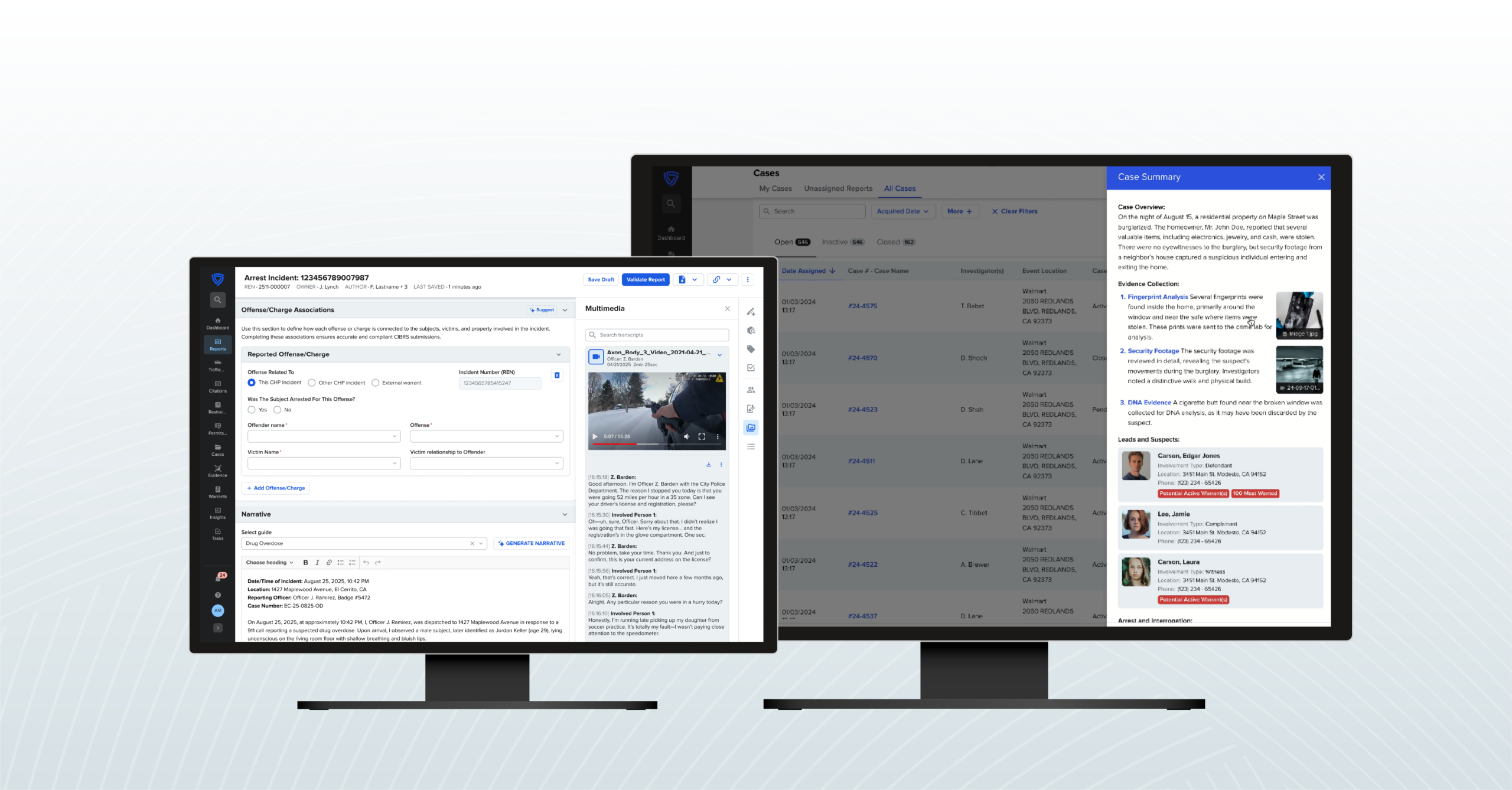
ReportAI enables patrol officers to complete accurate, policy-compliant reports in the field, often before they leave the scene. Drawing on CAD data, body-worn camera transcripts, officer notes, and full event context, it generates comprehensive first drafts in seconds. Narratives are auto-generated, structured fields are pre-populated, and repetitive data entry is eliminated.  

Built-in validations check for completeness, narrative quality, and policy compliance before submission, catching issues early, reducing downstream corrections, and improving supervisor review. Officers remain in control at every step through role-based permissions and oversight. 

BriefAI: Case Intelligence for Investigators and Command Staff   

BriefAI gives supervisors, investigators, and command staff instant visibility into case scope and complexity. It generates concise, standardized summaries capturing who, what, when and where, and what needs to happen next.  

Outstanding actions and next steps are surfaced to reduce rework and keep cases moving, with inline citations linking directly to source data for transparency and defensibility, accelerating case assignment and enabling more confident investigations. BriefAI flags the gaps rather than filling it with assumptions, ensuring accuracy and trust at every stage of an investigation.  

ReportAI and BriefAI are designed to align to each agency’s policies, workflows, and legal requirements, not the other way around. Compliance validations and AI permissions are configurable at the report and offense-code level, allowing agencies to control where AI is applied. Full draft history is maintained with every AI interaction logged for auditability. All data remains within Mark43’s secure, CJIS-compliant environment. 

Mark43’s Responsible AI Approach 

Mark43’s responsible AI framework is built on four principles: 

  • Human-First by Design: AI supports human judgment; it does not replace it.  
  • Built into Existing Public Safety Workflows: AI capabilities are embedded directly into existing systems and governance structures.   
  • Transparency and Validation: All AI outputs are visible, traceable, and auditable.  
  • Security, Privacy, Compliance, and Ethics: Data remains protected within a CJIS-compliant environment and is never used to train models without explicit agreement.  

Wendy Gilbert, SVP of Product at Mark43, said, “Every vendor is talking about AI right now. What we hear from agencies is that they want to move forward, but not at the cost of control, security, or public trust. ReportAI and BriefAI run inside the same CJIS-compliant environment agencies have already audited and approved, with full transparency into every AI-generated output and agency-level control over exactly where and how AI is used. We’re proud to give agencies a responsible path forward they can stand behind, with their officers, their city councils, and their communities.” 

ReportAI and BriefAI are now available to all Mark43 customers. To learn more, book a demo today. 

Unite.AI: Wendy Gilbert, Senior Vice President of Product, Mark43 – Interview Series

By: Antoine Tardif, CEO & Founder of Unite.AI

Wendy Gilbert, Senior Vice President of Product at Mark43, brings more than two decades of experience in public safety technology, with a career spanning product management leadership roles across organizations like CentralSquare Technologies, TriTech Software Systems, and VisionAIR. Having steadily advanced through roles focused on records management systems (RMS) and public safety platforms, she now leads product strategy at Mark43, where she is responsible for shaping the evolution of cloud-native solutions used by law enforcement agencies. Her tenure reflects a deep specialization in modernizing mission-critical software for first responders, with a focus on usability, compliance, and operational efficiency in high-stakes environments.

Mark43 is a leading provider of cloud-native public safety software, offering an integrated platform that includes records management (RMS), computer-aided dispatch (CAD), analytics, and mobile tools designed for law enforcement and emergency services. Built on a SaaS architecture, the platform enables agencies to streamline report writing, manage cases, and access real-time data from anywhere, significantly reducing administrative workload and improving response times. Its systems are designed to replace legacy infrastructure with scalable, secure, and mobile-first solutions, helping over hundreds of agencies enhance situational awareness, collaboration, and overall public safety outcomes.

You’ve spent over two decades building products across companies like VisionAIR, TriTech, CentralSquare, and now Mark43. How has your perspective on public safety technology evolved, and what feels fundamentally different about this current wave of AI adoption?

Technology has changed a lot over the past two decades. For most of that time, technology was designed to support the mission after the fact. Systems captured what happened, but they did not actively help shape what should happen next. That is what is fundamentally different now.

For the first time, we are not just adding technology to public safety workflows. We are reimagining those systems as AI-native from the ground up, which entirely changes the role technology plays. We are moving from systems of record to systems of action. Instead of just documenting incidents, we are helping agencies interpret, prioritize, and act in real time. This is the first time in my career that I have seen technology truly operate at the speed public safety deserves, which is to deliver products that can transform how agencies function day-to-day and ultimately deliver better public safety outcomes.

Mark43’s research shows strong support for AI among law enforcement, but also a clear expectation for human oversight. What does meaningful human involvement actually look like in day-to-day operations?

In every product decision we make, the principle is clear. AI supports. Humans decide.

AI can structure a report, surface links across records, or highlight key information in a call. But an officer, a dispatcher, or an investigator is always the one applying judgment and making the call. In practice, that means AI accelerates the path to insight while keeping accountability with the human. It drafts, suggests, and connects, but it does not decide.

That is especially important in CAD and RMS workflows, where decisions carry real consequences. The role of AI is to reduce friction and cognitive load so public safety professionals can focus on all that requires their expertise.

A recurring concern is whether AI-assisted reports and decisions will hold up in court. How do you design systems that are not only operationally useful but also legally defensible?

Coming from a CAD and RMS background, defensibility is not a “nice-to-have”. If records from a system cannot stand up in court, the tools are not ready for public safety use.

This starts with transparency. Every AI-generated output must be directly linked to its source data. Users need to be able to trace exactly where information came from, how it was generated, and how it was used. If that chain is not clear, the system will not hold up under scrutiny. The system also needs to know its limits. When data is incomplete, we design AI to surface that gap, not attempt to resolve it on its own. It does not guess.

Another critical piece is alignment with how agencies actually operate. AI cannot dictate policy or workflow. It must conform to the legal requirements, reporting standards, and operational realities of each agency.

We build configurability directly into the system. Compliance validations and AI permissions can be set at the report and offense-code level, so agencies can choose where AI assistance is appropriate and where it is not. For example, an agency may enable AI support for lower-level incidents while restricting it in cases that carry a higher evidentiary standard.

We also maintain full transparency into how AI is used. Every instance of AI involvement is logged, and full draft history is preserved within the report. That creates a clear, reviewable record that supports both internal accountability and external legal scrutiny.

These systems must stand up to scrutiny from supervisors, attorneys, and the public to be operationally useful and effective.

From your experience, where is AI already delivering measurable value in public safety today, and where is it still falling short of expectations?

The most immediate value is in the core workflows I have worked on my entire career.

Report writing is essential, but it’s also a persistent drain on time. AI is changing that by turning documentation into something that happens alongside the work, not after it. That is a meaningful shift for officers and agencies managing staffing constraints.

But the bigger shift is happening in how agencies move from information to action. AI can surface what matters in real time, not just after the fact. Where I see the gap is not in the technology. It is in how organizations operationalize it. AI requires clear policies, governance, and training to be effective. Agencies that treat it as a workflow transformation are seeing results. If agencies see it only as a feature, it won’t unlock the same opportunity.

Bias remains one of the most critical challenges in AI, especially in law enforcement where historical data can reflect systemic issues. How does Mark43 approach mitigating bias while maintaining accuracy and trust in its systems?

Bias is a real concern, especially in systems that rely on historical data.

From a product standpoint, the answer is not to obscure how the system works. It is to make it more transparent and more accountable. We focus on improving data quality at the point of entry, making outputs consistent, and ensuring there is always human review. In CAD and RMS systems, better data leads to better decisions. AI should reinforce that, not undermine it.

The goal is to ground decisions in more complete and consistent information, while ensuring every output can be examined, audited, and improved over time.

Transparency and auditability are often discussed as requirements for responsible AI. What does full auditability look like in practice for agencies using AI-driven tools?

In public safety systems, auditability has always been essential. AI raises the bar.

For agencies using AI, there should be complete visibility into what was generated, what data informed it, and how it was used. Nothing should exist without a clear connection back to the underlying record. Every output should be explainable. Every step should be reviewable. That is how you build systems that can be trusted, not just operationally, but publicly.

Many public safety agencies still rely on legacy systems and fragmented data. How important is infrastructure modernization before AI can truly deliver meaningful results?

AI is only as powerful as the foundation it sits on. I have worked with legacy CAD and RMS environments for much of my career, and I have seen firsthand how much fragmented systems limit what agencies can do. Investigators using these systems often have to query multiple tools just to understand a single case. That is not sustainable.

AI depends on connected, accessible data. If systems are siloed or require manual workarounds, AI cannot deliver meaningful outcomes. It becomes another layer of complexity instead of a force multiplier. Modern, cloud-native infrastructure unlocks the possibility for AI across an entire connected platform.

There is growing interest in AI systems that can take action rather than just provide insights. Do you see a future where AI actively participates in workflows like case management or dispatch, and where should boundaries be set?

AI will continue to move deeper into workflows, especially in areas like call handling, triage, and case management. It will increasingly coordinate workflows, prioritize actions, and surface the next best steps in real time. However, in public safety, there will need to be clear boundaries. AI can recommend, prioritize, and elevate key information. It can reduce the time it takes to move from information to action. But decisions that affect people’s lives must remain with trained professionals. Our goal is clarity and confidence at the right moment.

Public trust is essential in policing, particularly when new technologies are introduced. What safeguards are most effective in ensuring AI strengthens trust rather than undermines it?

We recognize that trust is something public safety agencies work to earn every day. Technology has to meet that same standard. For AI, that starts with visibility and transparency. Users need to understand what the system is doing and why. It also requires consistency, governance, and the ability to review outcomes over time. We build with a feedback loop directly from the field, because trust is established through real-world use and continuous validation.

Looking ahead over the next few years, how do you expect the role of AI in public safety to evolve from administrative support toward real-time decision-making?

AI will become embedded across the full lifecycle of public safety, from the moment a call comes in to how a case is resolved. The biggest shift will be how quickly agencies can move from information to action. That has always been the challenge in CAD and RMS systems. We are moving toward a model where the system understands how your agency operates, anticipates the first steps in a workflow, and helps execute them, all while remaining human-centered.

The role of AI is to reduce administrative burden, unify fragmented systems, surface the right information at the right time, and support better decisions under pressure. AI cannot replace experience. It helps ensure the people on the front lines are better informed, prepared, and supported in every decision they make.

Original Story: https://www.unite.ai/wendy-gilbert-senior-vice-president-of-product-mark43-interview-series/