The North Miami Police Department has deployed Mark43 as part of its Five-Year Strategic Plan that represents its collective vision and goals for a more proactive police department, anchored by a core commitment to leveraging modern technology to enhance efficiency and public safety.
The North Miami Police Department has implemented the Mark43 system as part of its strategic plan.
The deployment is aligned with the department’s goal to become more proactive in its operations.
Emphasis is placed on using modern technology to boost efficiency and public safety.
The North Miami Police Department (NMPD) has deployed Mark43, a leading cloud-native public safety operations platform, bringing its dispatch, records, analytics, and mobile operations together on one modern, cloud-native system.
Serving more than 60,000 residents across 10 square miles, the department’s 125 sworn and 30 professional staff are now operating on an upgraded technology platform designed to enhance efficiency, visibility, resiliency, and service to the community.
Under the leadership of Chief Cherise G. Gause, NMPD developed a Five-Year Strategic Plan that represents its collective vision and goals for a more proactive police department, anchored by a core commitment to leveraging modern technology to enhance efficiency and public safety.
“This upgrade isn’t just for the Police Department; it’s for the entire City of North Miami,” Gause said. “As the City of North Miami has continued to grow and evolve over the years, so have the operational and technology needs of our Police Department. As such, it became important to transition to a more modern platform that can better support our officers, improve efficiency, and meet the expectations of a growing community. This new system now gives our officers the tools they need to work more efficiently and safely. With Mark43, we have real-time data at our fingertips, allowing us to provide the most efficient, accurate information possible to support our community.”
“Florida agencies are increasingly investing in modern public safety technology to better serve their communities, and we’re proud to help meet that demand,” said Bob Hughes, CEO of Mark43. “Chief Gause and the North Miami Police Department’s commitment to operational excellence and community safety make them an outstanding partner as they build a more efficient and resilient future.”
For agencies in South Florida, resilient technology is essential, Mark43 said. As hurricanes and severe weather threaten local infrastructure year-over-year, agencies risk losing power and disruptions to the systems that keep their communities safe.
By upgrading to a cloud-native platform, NMPD ensures its mission critical systems remain stable and connected even if on-premises environments are compromised. Built in the AWS GovCloud, Mark43 provides the highest level of resiliency, connectivity, and security to keep officers and the community safe during all conditions.
“Resiliency is always something we must consider, especially during hurricane season. Knowing that our systems will now remain operational despite any potential local disruptions is important. Mark43’s cloud-native architecture gives us a level of stability, security, and continuity that is required for our work and keeping our community safe,” added Gause.
The NMPD will utilize a number of products from Mark43’s innovative portfolio:
The interoperability of Mark43 CAD and RMS will ensure all users, from telecommunicators and investigators to command staff, share the same source of truth.
Mark43 RMS streamlines and automates NMPD’s reporting workflows, reducing errors, and improving efficiency.
With the automated reporting and real-time dashboards within Mark43 Insights, leaders, analysts, and investigators gain instant insights into emerging trends and resource needs.
Mark43 OnScene enables NMPD to work more safely and effectively from the field.
North Miami Police Department joins surrounding agencies using the Mark43 Public Safety Platform. Those are:
Coral Gables Police Department
Miami Gardens Police Department
Bay Harbor Islands Police Department
Venice Police Department
Boynton Beach Police Department
Fort Myers Police Department
Miami Springs Police Department on the Mark43 Public Safety Platform
NEW YORK – August 21, 2026 – The North Miami Police Department (NMPD) has launched on Mark43, the leading cloud-native public safety operations platform, bringing its dispatch, records, analytics and mobile operations together on one modern, cloud-native system. Serving more than 60,000 residents across 10 square miles, the department’s 125 sworn officers and 30 professional staff are now operating on an upgraded technology platform designed to enhance efficiency, visibility, resiliency, and service to the community.
Under the leadership of Chief Cherise G. Gause, NMPD developed a Five-Year Strategic Plan that represents its collective vision and goals for a more proactive police department, anchored by a core commitment to leveraging modern technology to enhance efficiency and public safety. “This upgrade isn’t just for the Police Department; it’s for the entire City of North Miami,” shared Chief Gause. “As the City of North Miami has continued to grow and evolve over the years, so have the operational and technology needs of our Police Department. As such, it became important to transition to a more modern platform that can better support our officers, improve efficiency, and meet the expectations of a growing community. This new system now gives our officers the tools they need to work more efficiently and safely. With Mark43, we have real-time data at our fingertips, allowing us to provide the most efficient, accurate information possible to support our community.”
Bob Hughes, CEO of Mark43, shared, “Florida agencies are increasingly investing in modern public safety technology to better serve their communities, and we’re proud to help meet that demand. Chief Gause and the North Miami Police Department’s commitment to operational excellence and community safety make them an outstanding partner as they build a more efficient and resilient future.”
For agencies in South Florida, resilient technology is essential. As hurricanes and severe weather threaten local infrastructure year-over-year, agencies risk losing power and disruptions to the systems that keep their communities safe. By upgrading to a cloud-native platform, NMPD ensures its mission critical systems remain stable and connected even if on-premises environments are compromised. Built in the AWS GovCloud, Mark43 provides the highest level of resiliency, connectivity, and security to keep officers and the community safe during all conditions.
“Resiliency is always something we must consider, especially during hurricane season. Knowing that our systems will now remain operational despite any potential local disruptions is important. Mark43’s cloud-native architecture gives us a level of stability, security, and continuity that is required for our work and keeping our community safe,” shared Chief Gause.
The NMPD will utilize a number of products from Mark43’s innovative portfolio:
The interoperability of Mark43 CAD and RMS will ensure all users, from telecommunicators and investigators to command staff, share the same source of truth.
Mark43 RMS streamlines and automates NMPD’s reporting workflows, reducing errors, and improving efficiency.
With the automated reporting and real-time dashboards within Mark43 Insights, leaders, analysts, and investigators gain instant insights into emerging trends and resource needs.
Mark43 OnScene enables NMPD to work more safely and effectively from the field.
North Miami Police Department joins surrounding agencies including Coral Gables Police Department, Miami Gardens Police Department, Bay Harbor Islands Police Department, Venice Police Department, Boynton Beach Police Department, Fort Myers Police Department, and Miami Springs Police Department on the Mark43 Public Safety Platform.
What if collecting critical intelligence for a gun investigation that once took two weeks could happen in six hours?
Technology alone won’t solve gun violence. Experienced investigators, strong partnerships between law enforcement agencies and community-based strategies will always be essential. However, giving investigators faster access to critical information can allow them to spend less time moving data between systems and more time acting on intelligence.
My company worked with the Louisville Metro Police Department, and automating the submission of data from firearms used during criminal activity—commonly referred to as “crime guns”—reduced processing time by an average of 95%, cutting turnaround from 10 to 14 days to as little as six hours while saving an estimated 3,500 staff hours annually. Faster access to crime gun intelligence gives investigators more time to follow leads, connect cases and build stronger investigations instead of manually moving information between systems.
Crime gun investigations depend on timely, accurate information. Much of that intelligence comes from collaboration with the Bureau of Alcohol, Tobacco, Firearms and Explosives (ATF), whose systems help investigators trace firearms and identify connections that might otherwise go unnoticed.
Powerful investigative tools exist.
ATF’s program eTrace traces crime guns to their original purchaser. The National Integrated Ballistic Information Network (NIBIN) and the NIBIN Enforcement Support System (NESS) help identify ballistic and intelligence links between shootings and provides investigators with valuable intelligence that can connect cases, identify suspects and uncover patterns across jurisdictions.
Consider a firearm recovered during a traffic stop or at the scene of a shooting. A trace can identify where the firearm was first sold, while ballistic information may link it to other shootings, even across jurisdictional boundaries. When investigators receive that information quickly and in the context of the case they’re already working, they can build a more complete picture of what happened.
That makes it easier to identify links between firearms, incidents and suspects, particularly when investigations cross jurisdictions. A firearm recovered in one community may be connected to a shooting hundreds of miles away. The sooner investigators receive that information, the sooner they can follow new leads, coordinate with partner agencies and build stronger cases.
Technology can help, but accuracy depends on people, not just tech.
While these systems are powerful investigative tools, many agencies still rely on manual processes to submit information and retrieve results. Firearm details are often manually entered into a records management system and then re-entered into ATF systems later by another person. When trace results come back, someone has to retrieve them, match them to the correct case and enter them into the records management system again. Every handoff can risk introducing delays and errors.
Modern technology can help with that administrative work. Agencies can automate the transfer of crime gun information between their records management systems and ATF systems, so investigators can receive trace and ballistic information sooner. Reducing duplicate data entry can also help ensure investigators are working from complete, accurate information.
However, automating data transfer only helps if the data going in is accurate and comprehensive. Leaders need to train investigators and records staff on what a clean submission looks like, not just how to use the software. A typo in a serial number or a wrong make and model can send an investigator down the wrong path just as easily as a slow manual process can.
Strong partnerships are also integral to the success of technology. Ensuring there are point people on both sides—so that when a result looks unusual, you have someone to call instead of a ticket to file—is the difference between confirming a lead rapidly and waiting.
What should leaders ask before adopting new technology?
When selecting a new technology tool to support faster gun crime investigations, leaders should ask possible vendors a few specific questions. How does the system validate data before submission, and what happens when something fails validation? Does the platform return results directly to the case file with context attached, or does an analyst still have to piece that picture together by hand?
It’s also worth asking how a vendor keeps pace when ATF updates its own systems. A tool that can’t adapt will recreate the same bottlenecks it was meant to solve. It is also important to make sure an agency’s own records system is up to date. If case data is inconsistent, or different units enter information differently, no amount of automation will fix that. Leaders should audit their own data practices before or alongside any new rollout.
What I said in the beginning bears repeating: Technology alone won’t solve gun violence. Experienced investigators and strong partnerships will always be essential. However, the faster investigators can access crime gun intelligence, the faster they can connect cases, follow leads and help bring offenders to justice.
Mark43 doubles footprint in state, particularly South Florida
From hurricanes and large-scale emergency response to rapidly growing populations and complex regional coordination, Florida public safety agencies require technology that is resilient, secure, and built to keep critical operations running in moments that matter most. To that end, over the last 18 months, Mark43, which provides modern dispatch, AI-powered reporting, analytics and mobile tools, reports it has doubled its footprint across Florida.
The Mark43 Public Safety Platform combines Computer-Aided Dispatch (CAD), Records Management System (RMS), OnScene mobile workflows, Insights, AI-powered tools and an open platform architecture that supports Florida-specific compliance requirements. Mark43’s cloud-native architecture provides agencies with resilience during hurricanes, cyber threats, and other critical incidents.
“Public safety leaders across Florida are embracing technology that helps their teams work smarter and respond faster,” said Bob Hughes, CEO of Mark43. “We’re proud to provide the cloud-native, AI-powered platform that helps agencies streamline operations, reduce administrative burden, and focus more time on serving their communities.”
For example, the Bay Harbor Islands Police Department brought its critical systems onto one platform, strengthening disaster recovery and enabling instant data sharing across Miami-Dade County. Coral Gables PD detectives now have case files and body cam footage on one platform at their fingertips. Miramar PD has trusted Mark43 for six years with the platform growing alongside the department’s needs, including integration with Broward County CAD for stronger regional coordination. Other recent South Florida customers of Mark43 include the police departments in Homestead, North Miami, Miami Springs and Boynton Beach.
NEW YORK – August 13, 2026 – From hurricanes and large-scale emergency response to rapidly growing populations and complex regional coordination, Florida public safety agencies require technology that is resilient, secure, and built to keep critical operations running in moments that matter most. Over the last 18 months, Mark43 has doubled its footprint across Florida, representing a statewide movement toward more connected, resilient public safety operations.
“Public safety leaders across Florida are embracing technology that helps their teams work smarter and respond faster,” said Bob Hughes, Chief Executive Officer of Mark43. “We’re proud to provide the cloud-native, AI-powered platform that helps agencies streamline operations, reduce administrative burden, and focus more time on serving their communities.”
The Mark43 Public Safety Platform combines Computer-Aided Dispatch (CAD), Records Management System (RMS), OnScene mobile workflows, Insights, AI-powered tools and an open platform architecture that supports Florida-specific compliance requirements, including FIBRS and NIBRS reporting.
Mark43’s cloud-native architecture provides agencies with resilience during hurricanes, cyber threats, and other critical incidents. It is the only CAD and RMS solution that is FedRAMP High and GovRAMP High Authorized, providing agencies with industry-leading security and resiliency.
Recent partnerships with the Homestead Police Department and North Miami Police Department reflect what investment in a modern public safety platform means for officers and communities:
Chief Cherise G. Gause of the North Miami Police Department shared, “This upgrade isn’t just for the Police Department; it’s for the entire City of North Miami. As the City of North Miami has continued to grow and evolve over the years, so have the operational and technology needs of our department. This new system will give our officers the tools they need to work more efficiently and safely with real-time data at their fingertips to deliver the most accurate information possible to our community.”
Chief Mario Knappof the Homestead Police Department shared, “We need tools that actually work for us. Mark43 does that—it’s NIBRS-compliant, fully integrated with Florida’s systems, and it scales as we grow. But what matters most is what it lets us do: serve our community better, faster, with the accountability they deserve.”
Recent deployments across the state at the Miami Springs Police Department, Venice Police Department and Bay Harbor Islands Police Department reinforce the value in an implementation partner that is there every step of the way:
Deputy Chief Albert Vargas of the Miami Springs Police Department shared, “This launch is transformative for our officers, sergeants, command staff, dispatchers, and records personnel, and the impact extends well beyond implementation. Mark43 has already provided a stronger foundation for public safety operations, improved access to information across the organization, and helped ensure our personnel have the tools they need to better serve and protect the public.”
Captain Eric Hill of the Venice Police Department shared, “Having overseen numerous technology projects at our department, I can confidently say that Mark43 has been the best implementation team I’ve worked with. From sales through implementation, Mark43 demonstrated an exceptional commitment to ensuring a successful rollout and maintaining a strong customer relationship.”
Chief Luis E. Alvarez of the Bay Harbor Islands Police Department shared, “Mark43 brought our critical systems into one connected platform, and the difference is immediate. We now have better tools to support daily operations, stronger disaster recovery preparedness, and seamless data sharing with agencies across Dade County.”
Through hurricanes and major incidents, long-standing customers demonstrate what a reliable, resilient partnership looks like, ensuring readiness for the challenges ahead:
Chief Ed Hudak of the Coral Gables Police Department shared, “Mark43 has made us faster and more effective at solving crimes. Detectives have case information at their fingertips the moment they need it. Everything we’ve asked the system to do, from CAD and RMS to integrations with body cameras, drones, and other critical platforms, has worked the way we needed it to. We’re taking bad people off the street because information flows faster and more consistently than ever before.”
Chief Jason Fields of the Fort Myers Police Department shared, “As a Florida PSAP and law enforcement agency, we depend on technology that can support critical operations through severe weather and hurricane conditions. Mark43 has been a reliable and collaborative partner, keeping critical operations up and running during Hurricane Ian and giving our personnel the continuity and confidence they need to serve our community.”
Chief Joseph DeGiulio of the Boynton Beach Police Department shared, “Officers should be focused on serving the community and staying out in the field, not worrying about arduous workflows. We live in a world where people expect information to be two clicks away, and Mark43 CAD and RMS continues to move us in that direction with a system that’s intuitive, efficient, and built around how officers actually work. The technology has been great, but just as important has been the partnership. We’ve had strong support, great relationships, and a team we can count on.”
Chief Delrish Moss of the Miramar Police Department shared, “Six years into our partnership, Mark43 continues to deliver. As the Miramar Police Department has evolved, the platform has grown with us, providing our personnel with a modern, reliable records management system and stronger regional coordination through its integration with Broward County CAD. Mark43 has earned our confidence by listening to the needs of law enforcement, responding to feedback and continuously improving its technology to better support public safety.”
Commander Erik Gleason of the Miami Gardens Police Department shared, “Miami Gardens rightfully demands a lot from its police department and our technology has to match that. Mark43 connects our critical systems, improves coordination, and turns data into insight our team can actually use.”
Ready to modernize your operations and join the growing network of agencies operating on Mark43? Connect with us and learn more at www.mark43.com.
MANCHESTER, UK – 31 July 2026 – Mark43, the leading public safety operations supplier, has been shortlisted for the 2026 UK IT Industry Awards as Vendor of the Year, one of the most respected recognitions in the UK technology sector.
Now in their 16th year, the UK IT Industry Awards, run by the British Computer Society, The Chartered Institute for IT and Computing, celebrate the people, projects and organisations shaping the future of technology in the UK. The Vendor of the Year category judges companies against excellence in market growth and customer satisfaction, diversity and inclusion in the workplace, technology innovation, and investment in the UK.
Tom Allen, Editorial Director of Computing, said “Being shortlisted in the UK IT Industry Awards is a fantastic achievement, recognising those who make the list as leaders in the competitive and fast-moving UK tech landscape. The quality of entries and innovation continues to improve every year, and we can’t wait to celebrate our entrants’ success at the 2026 awards.”
“This recognition belongs to the police forces we work with every day, whose officers and staff work tirelessly to keep the public safe,” said Matt Polega, Co-Founder and Managing Director UK. “Building technology that matches that responsibility is why we opened our doors in the UK, and why we’re proud to continue meeting the demand for modern solutions. Being named among the top suppliers in the country is a real honour for the team, and it spurs us on to keep raising the bar every day.”
Winners will be announced at the awards ceremony on 11 November 2026 at Battersea Evolution, London.
About BCS, The Chartered Institute for IT
The British Computer Society, branded ‘BCS, The Chartered Institute for IT’, is a professional body and a learned society that represents those working in information technology, computing, software engineering and computer science, both in the United Kingdom and internationally. As a charity with a royal charter, its agenda is to lead the IT industry through its ethical challenges, to support the people who work in the industry and to make IT good for society. Founded in 1957 it has 70,000 members. Website: https://www.bcs.org
NEW YORK – July 30, 2026 – Mark43, the leading cloud-native public safety operations platform, today announced the Putnam County Society for the Prevention of Cruelty to Animals (SPCA) is set to deploy its Computer-Aided Dispatch (CAD), Records Management System (RMS) and OnScene mobile app to modernize dispatch, incident reporting, case management, investigations and field operations.
Putnam County SPCA serves a unique role in New York State’s public safety ecosystem. Working alongside Putnam County 911, the Putnam County Sheriff’s Office, local police departments, New York State Police and New York State Environmental Conservation Police, the agency leads investigations into animal cruelty and related criminal offenses, including domestic violence, protects vulnerable animals and people, and helps hold offenders accountable under New York State law.
“Mark43 is light years ahead,” said Chief Ken Ross of Putnam County SPCA. “For years we’ve been working around the limitations of legacy technology, manually moving information between systems and spending time trying to piece together details that should already be there. With Mark43, our people won’t be flying blind. They can help animals in need, do their job safely, and get home.”
“We’re proud to meet the growing demand across New York for modern technology that helps officers work smarter, faster, and keep their communities safer,” said Bob Hughes, CEO of Mark43. “Chief Ross and his team are out there every day investigating animal cruelty and protecting some of the most vulnerable. We’re proud to support that work.”
More Information, Faster Dispatch
Putnam County SPCA receives calls around the clock from residents, surrounding agencies and public safety partners, ranging from reports of neglected or injured animals to active cruelty investigations where officers must respond with accurate information immediately.
For the first time, the agency will have real-time visibility into unit locations. The live map within Mark43 CAD shows dispatchers and officers nearby units, resources, and location details for smarter response and better officer safety.
“We don’t have a way to see where our units are or quickly pull information while a call is unfolding,” Chief Ross said. “With Mark43, we’ll have better information from the moment the call comes in. Everything will carry through into the investigation without losing details so we can stop wasting time chasing down information we should already have.”
In 2025, Putnam County SPCA responded and investigated nearly 2,600 blotter entries, a 9% increase from 2024. In 2026, the agency is tracking and expecting another 10% increase in activity. Chief Ross estimates the new system will eliminate up to 20 minutes of administrative work per call, freeing officers to get back in the field.
Accurate Data, Complete Records, and Stronger Advocacy
Mark43 RMS will help officers create complete and accurate reports. Whether documenting animal cruelty investigations or related criminal offenses, this system makes it easier to identify recurring patterns across investigations, locations and offenders, build stronger cases, and collaborate more effectively with partner agencies. Built-in NIBRS validation and CJIS compliance reduce administrative burden.
As a certified 501(c)(3) nonprofit organization, Putnam County SPCA must demonstrate the breadth of its work to county leaders while documenting investigations that often involve multiple agencies and jurisdictions. With Mark43, Putnam County SPCA can analyze and generate reports to support operational planning and funding decisions.
“Every year we’re asked to show what we’re doing. Today that means sorting through reports one by one—manually,” shared Chief Ross. “With Mark43, we’ll be able to clearly show where we’re responding, what cases we’re handling and the impact we’re making. That transparency will help us advocate for the funding we need to advance our mission.”
Mobile Intelligence for Smarter, Safer Response
Animal cruelty calls often signal larger public safety concerns. Officers responding to reports of neglect, abuse or abandoned animals, regularly encounter domestic violence, child welfare issues, elder abuse or illegal weapons. Access to accurate information before arriving on scene will help officers prepare and respond with greater awareness.
Using Mark43 OnScene, officers can securely access CAD and RMS information from mobile phones, review address history, and begin documenting investigations directly in the field.
Chief Ross shared, “Nine times out of ten, we don’t know exactly what we’re walking into. Having location history, previous incidents and important safety information at our fingertips will give our officers a much clearer picture of the situation. It will help us respond smarter, faster, and stay safer.”
As Putnam County SPCA modernizes its operations with Mark43, community support remains essential to its mission. Community members can support by donating, volunteering, reporting suspected animal cruelty or helping raise awareness of its work. To learn more or get involved, visit www.spcaputnam.org.
About Putnam County SPCA
Putnam County SPCA is a 501(c)(3) nonprofit charitable organization and NYS-certified law enforcement agency with full police powers to enforce New York State criminal and animal cruelty laws. The agency works to prevent animal cruelty and related public safety incidents in Putnam County through law enforcement, investigations, animal protection, humane education and collaboration with local, county and state public safety partners. To donate, volunteer or report suspected animal cruelty, visit https://spcaputnam.org or call 845-520-6915.
Ask most people what police officers do all day, and they’ll describe what they see on TV: fighting crime, making arrests and solving cases. That work is important. But it’s not the full picture.
Modern policing is largely about responding to the everyday issues that shape community life: traffic crashes, mental health calls, welfare checks, neighborhood disputes and noise complaints—the calls that don’t as often make the news.
And then there’s the part almost no one sees: the paperwork.
Every call, stop, report, arrest and follow-up creates an administrative trail. Officers spend hours writing reports, pulling information from disconnected systems, re-entering the same details and checking their work. According to the 2024 Arizona Law Enforcement Retention Survey, officers spend one-quarter or more of their time on administrative tasks, far more than time spent on search and rescue, event security or community outreach.
Every hour spent in software systems or chasing down information is an hour officers aren’t spending in the community.
The Data-Rich, Bandwidth-Strapped Reality Of Policing
Modern policing generates more information than ever: body-worn camera transcripts, video evidence, computer-aided dispatch (CAD) and records management system (RMS) data, officer notes and more. More information should mean better reports, stronger cases, greater transparency and more complete records. But for too many agencies, turning that data into a complete, compliant police report is still painfully manual, time-consuming and prone to error.
The challenge only grows as police agencies face staffing shortages, increased workloads, growing call volumes and more regulatory scrutiny. Officers are expected to document incidents with greater precision than ever, while facing constant interruption. New calls come in. Priorities shift. Officers get pulled away mid-report and hours later must try to reconstruct details from memory. Even after submission, reports frequently bounce back for corrections, forcing officers to sit at their desks instead of returning to the community.
Investigators face the same problem at a different scale. A 2025 study (download required) from the city of Albuquerque found that nearly 96% of completed complaints against officers involve some form of video, most of it from on-body recording devices (OBRD). Reviewing and summarizing video can take hours, and video is just one small part of the information that investigators must analyze.
Worse yet, investigators may spend hours reviewing a report only to find a single omission or procedural issue that can undermine an otherwise prosecutable case.
The Cost Goes Beyond Productivity
The impact is bigger than lost time. When details are missing, reports move back-and-forth between an agency, the city and the courts. Investigations slow down. Cases take longer to move through the justice system. People wait longer for answers. We’re hearing this directly in the field. One agency my company worked with shared that before moving to a modern, AI-powered RMS, in one week alone, 7 out of 10 arrest reports were sent back by courts due to errors, missing details or not following guidelines.
This administrative burden also takes a toll on recruitment, retention and morale. Many officers I’ve worked with have told me that report writing is the least enjoyable part of their job. Long hours spent finishing paperwork can cut into rest, recovery and family time.
This is where AI can offer meaningful operational change, but only if it is grounded in human judgement. AI-powered automation is an effective way to reduce administrative burdens, reclaim time, decrease frustration, improve accuracy and free people to do what they signed up for with greater confidence.
My company recently surveyed first responders and law enforcement personnel. We discovered that 77% of these workers found outdated technology to be a hindrance when doing their jobs. Ninety percent of those surveyed said automating data entry could streamline their roles, and 93% of those surveyed said they would “support their agency’s use of AI to improve operations.”
Agencies are beginning to see AI for what it can be: a practical tool for helping officers and investigators manage growing complexity with more speed, accuracy and confidence.
Five Ways Agencies Can Put AI To Work
For public safety agencies, the most valuable applications of AI are often the most practical ones:
• Use AI as a powerful validation tool to strengthen data integrity and reduce errors. AI can catch and flag errors or missing information earlier in the process to avoid ripple effects in critical reporting and investigation workflows.
• Position automated validation as a real-time training tool for officers. AI can help guide officers as they write, prompting them to capture the right details, meet reporting standards and align with policy. This should not replace supervisors. AI can act as an officer’s co-pilot, reinforcing reporting standards and helping officers identify issues earlier in the process. This can give newer officers the kind of intuitive, real-time support they increasingly expect from workplace technology.
• Program AI to pull from all critical data sources to connect the dots faster. Dispatch records, officer notes, reports and body-worn camera transcripts all contain important pieces of a story. AI can bring that information together, reduce repetitive data entry and ultimately accelerate investigations.
• Transcribe and organize body-worn camera videos and audio so people can actually use it. Video evidence is valuable, but reviewing it manually can take hours. AI can help officers and investigators to quickly search, review and verify key moments without manually combing through hours of footage. Searchable transcripts can significantly reduce review time while improving accuracy.
• Embrace responsible AI practices from the beginning. In public safety, trust matters. Agencies need AI that prioritizes transparency, human oversight, privacy, compliance and integration into existing workflows. AI should support human judgment, not replace it. The people doing the work must remain accountable for the decisions that affect communities.
When agencies embrace AI with the right mindset, the benefits can be significant: more accurate reports, fewer errors, less administrative burden and faster workflows. But the real promise of AI is helping officers spend less time behind a screen and more time where public trust is built: in neighborhoods, conversations and everyday moments that shape how communities experience public safety.
NEW YORK – June 29, 2026 – Mark43 today announced that the Port of San Diego Harbor Police Department (Harbor Police) has successfully deployed its cloud-native Computer-Aided Dispatch (CAD), First Responder and OnScene mobile applications, and Insights advanced analytics. The launch marks a significant milestone for Harbor Police, bringing a unified, mobile-first platform to the Port of San Diego.
Sharing San Diego Bay with approximately 24% of all U.S. Navy vessels and 17% of the Navy’s active-duty personnel, the Port is a uniquely complex and critical maritime and transportation hub for Southern California. Harbor Police is responsible for protecting the bay, San Diego International Airport, and critical maritime infrastructure. Unlike traditional police departments, officers routinely transition between foot patrol, vehicles, boats, airport terminals, waterfront facilities, and marine fire and rescue during a single shift.
“Launching this CAD system is a huge milestone for HPD,” said Captain Christopher Woodward at the Port of San Diego Harbor Police Department. “From day one, it was clear the partnership with Mark43 would be different. No other vendor comes close to the level of collaboration and commitment we received throughout this project. This launch is what happens when technology, people, and mission alignment come together.”
“The Port of San Diego Harbor Police plays a critical role in protecting the people, infrastructure, and commerce that keep the region moving,” said Bob Hughes, CEO of Mark43. “We’re proud to support their mission by ensuring officers have the information they need when and where they need it—whether on the water, at the airport, or in the field—helping them make faster decisions and work more effectively.”
Purpose-Built for Port and Transportation Policing
Now, with CAD, OnScene and First Responder, Harbor Police officers have access to live call information, maps, unit locations, and incident updates directly from their mobile devices and mobile data computers (MDCs), no longer relying solely on radio.
“Whether we’re on foot in the airport, responding on the waterfront, or operating from a patrol boat, having immediate access to information from a mobile device is a game changer. What once required multiple phone calls, radio transmissions, or manual updates can now be done in seconds. Officers can access and update information directly in the field, eliminating the need to fill valuable radio airtime with routine status updates, allowing dispatchers to focus on higher priority communications. This gives our personnel and command staff a level of situational awareness we’ve never had before,” said Christine McMillen, Civilian Manager, Communications and Records at the Port of San Diego Harbor Police Department.
These capabilities are especially valuable across the department’s diverse operations. Vessel units routinely respond to incidents using 16-character location coordinates transmitted over marine radio channels, which previously had to be manually recorded and entered while monitoring radio traffic. At San Diego International Airport, routine door checks, badge checks, and facility security activities often consumed valuable radio airtime. With Mark43, officers can access incident locations, complete routine activities digitally, reduce radio congestion, and respond more efficiently whether operating on the water or in a terminal.
The benefits were evident almost immediately following the launch. “When our chief needed information on an active incident, what used to take several back-and-forth phone calls was answered with a quick glance at my phone. Once everyone is fully onboarded, those calls may not need to happen at all,” shared Assistant Chief Jeffrey Geary of the Port of San Diego Harbor Police Department.
Secure, Data-Driven Public Safety Operations
Harbor Police also needed a platform that could support data-driven policing and evolving cybersecurity requirements. Mark43 Insights delivers advanced analytics dashboards, and automated reporting tools that help agency leaders quickly access information and make more informed decisions, while providing a secure and resilient foundation for daily operations.
“One of our goals was to give our teams better access to information while reducing the administrative burden of hosting an on-premises solution, fragmented reporting workflows and analysis,” said Maria Horne, Senior System Support Analyst at the Port of San Diego Harbor Police Department. “Equally important was ensuring we had a secure and resilient platform for our mission-critical operations. Mark43 gives us confidence in both our day-to-day operations and our long-term technology strategy, while delivering the analytics and search capabilities that will help us make more informed decisions going forward.”
Together, Mark43’s platform, mobile dispatching tools, and advanced analytics capabilities provide Harbor Police with the infrastructure needed to meet the evolving demands of modern port policing. The launch also reflects growing adoption of cloud-native public safety technology across Southern California, with the San Diego County Sheriff’s Office set to launch on the Mark43 platform later this year.
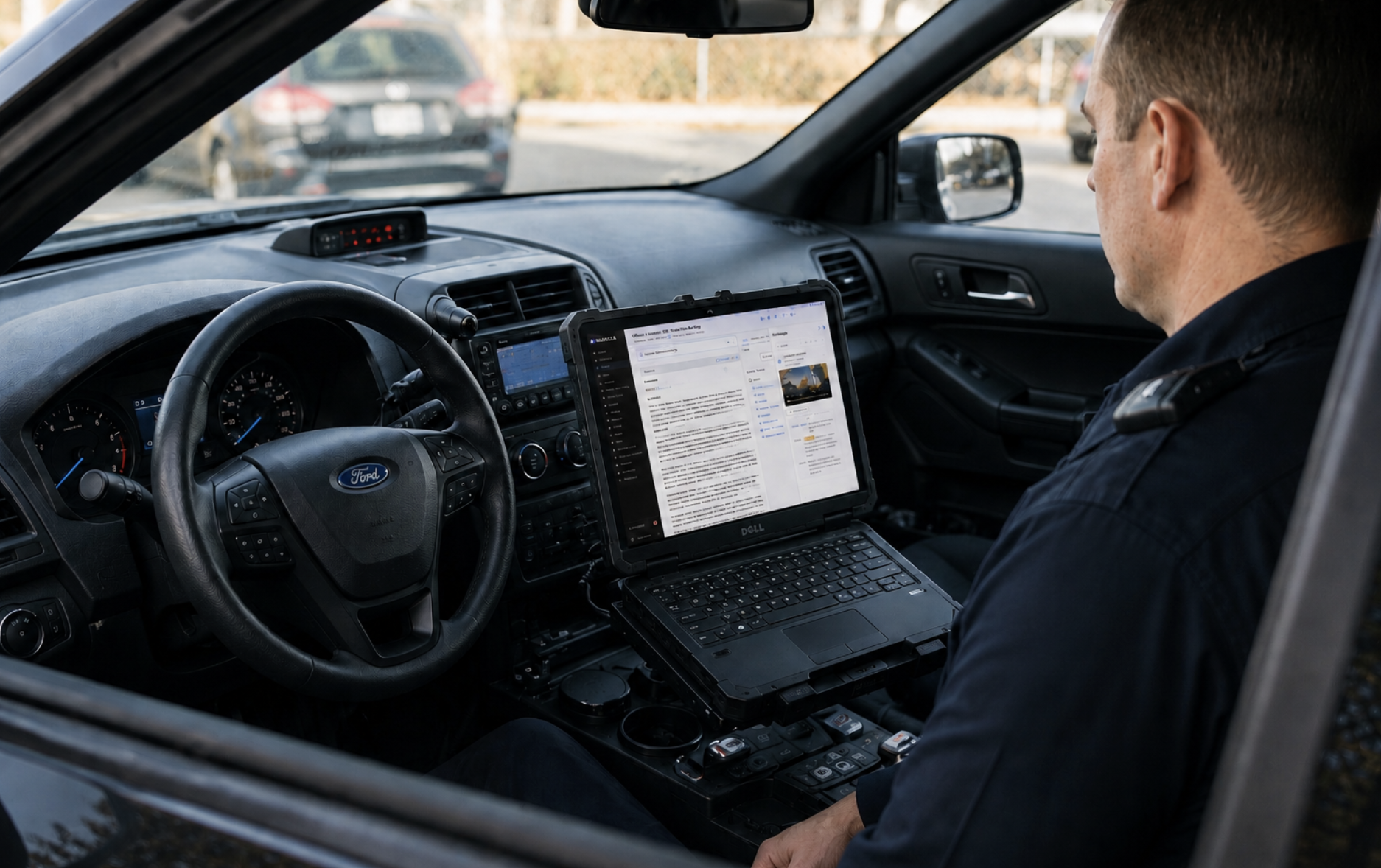
A police officer’s body-camera footage is transcribed directly into the ReportAI interface developed by software company Mark43. Police departments across the country are increasingly turning to artificial intelligence to help draft reports, analyze evidence and manage massive amounts of digital data from body cameras, surveillance systems and case files. (Photo courtesy of Mark43)
Hundreds of people fill a downtown street for a protest, waving signs and chanting as they march past businesses and government buildings. Overhead, a police drone records video of the crowd. Nearby traffic cameras and license plate readers capture faces, vehicles and movements along the route.
With artificial intelligence, experts say, hours of footage can be analyzed in minutes, making it easier for police to track or target a participant long after the demonstration ends.
As law enforcement agencies increasingly embrace AI, some civil liberties advocates, legal scholars and policing experts warn that the technology could amplify surveillance, introduce hidden biases into investigations and make it harder to challenge evidence in court. They also worry about a future in which AI takes on a more active role in policing and criminal investigations.
“It’s especially concerning sort of the ways that these tools could supercharge that kind of surveillance and enforcement,” said Rachel Levinson-Waldman, the director of the liberty and national security program at the Brennan Center for Justice, a nonpartisan law and policy organization at the New York University School of Law. Levinson-Waldman has written extensively about the risks of police surveillance and the unregulated use of AI in policing.
Artificial intelligence in policing is not new. For decades, law enforcement agencies have used data-driven and automated tools, including facial recognition systems, automated license plate readers, predictive policing models and video analytics that can flag objects or activity in recorded footage.
What is changing is the speed, scope and complexity of those tools. As police departments accumulate growing volumes of digital evidence — from body camera footage and surveillance video to jail calls, social media records and case files — AI is increasingly being used to help sort, search and analyze that information.
“AI is going to basically be able to sort through otherwise overwhelming amounts of data in ways that we just haven’t seen yet, and give police and prosecutors and the government a lot more power over us in ways that I think will be deeply uncomfortable for many of us,” said Andrew Guthrie Ferguson, a law professor at George Washington University and the author of “Your Data Will Be Used Against You: Policing in the Age of Self-Surveillance,” a book published this year.
Cris Moore, a computer scientist and professor at the Santa Fe Institute, a research and education center, said the technology is advancing faster than agencies, regulators and courts are able to fully assess its implications, raising questions about transparency, accountability and the role automated systems should play in policing decisions.
“It’s fair to say that the speed at which technologically created evidence has been adopted, and the aggression with which it’s being pushed makes it hard for the legal community to keep up,” Moore said.
State legislatures and police departments are still developing rules to govern how AI can be used in public safety settings. While some agencies have adopted internal policies or vendor-specific guidance, there is no consistent national framework, and state-level approaches remain limited and uneven.
At least two states, California and Utah, have recently enacted laws regulating the use of generative AI in police report writing, requiring disclosure when AI is used and adding safeguards around accuracy and oversight.
More broadly, more than a dozen states have passed laws regulating related technologies such as facial recognition, drone surveillance and automated license plate readers, according to the National Conference of State Legislatures.
Emerging tech
Some of the major companies offering AI-powered tools for law enforcement include Axon, Motorola Solutions, TRULEO, Flock Safety, Clearview AI and others. Their products can search body-worn camera footage, analyze large datasets, review digital evidence and case files and identify potential suspects through facial recognition.
Some of these systems are built into centralized platforms that are able to pull and search for data from sensitive databases and police records.
There are very real constitutional, statutory and practical risks with this new model of agentic policing. – Andrew Guthrie Ferguson, law professor at George Washington University
Mark43, a cloud-based software company serving more than 300 public safety agencies, offers two AI-powered tools. ReportAI helps officers draft reports using information from dispatch records and body camera footage, while BriefAI summarizes case information for investigators and supervisors.
Police agencies can choose which AI features to enable and who can access them, and the system maintains audit logs of AI-assisted activity. Mark43 told Stateline that dozens of agencies are using, testing out or evaluating the AI features.
“Our core mission is to help responders spend less time on administrative work, so that they can spend more time serving in their communities,” said Wendy Gilbert, Mark43’s senior vice president of product.
Some experts are wary of AI being used for decisions that could affect a person’s rights or freedom, such as identifying suspects, recommending enforcement actions or influencing arrests. Critics warn that AI-generated outputs can make mistakes, reflect biases in underlying data and create a risk that officers or investigators place too much weight on the technology’s recommendations.
They also argue that many AI systems operate in ways that are difficult for the public — and sometimes even officers — to fully understand.
One source of concern is the possible advent of “agentic policing.” Future technologies could integrate body-camera footage, camera networks and other data sources into a single system capable of generating investigative leads, identifying potential suspects or suggesting connections between cases.
Even if humans remain responsible for final decisions, critics say, such systems could shape investigative judgments in ways that make it more difficult to understand how conclusions were reached.
“All that data is going to be dumped into an AI model, and they’re going to query it to say who’s the most likely suspect,” said Ferguson of George Washington University. “The AI is going to be running the agentic analysis of it and come up with the answer, and then police and prosecutors have to kind of work backwards to see if it’s accurate.”
Ferguson warned that this flips the traditional investigative process on its head.
“We’ve never started with an answer and made people work backwards,” he said. “There are very real constitutional, statutory and practical risks with this new model of agentic policing.”
AI companies and some law enforcement agencies argue the technology is designed to assist officers, not replace them. They emphasize that officers are responsible for reviewing, verifying and approving AI-generated information, and that the tools are intended to reduce administrative work and help people navigate large volumes of data more efficiently.
“AI should increase accountability, not reduce it, and so we’re doing everything in our will to provide transparency, governance and human control,” said Zach Barden, the lead product manager for AI at Mark43.
In recent years, a growing number of police officers across the country have been accused of misusing AI-powered tools, including automated license plate reader systems, available through their departments to track people for personal reasons.
In April, a former Costa Mesa, California, police officer pleaded guilty to using law enforcement databases and Flock Safety cameras to monitor his wife, a mistress and several romantic rivals. Similar allegations have surfaced in Florida, Georgia, Idaho, Illinois, Kansas, Pennsylvania, Tennessee and Wisconsin.
Flock Safety, one of the nation’s largest providers of automated license plate readers, uses roadside cameras to capture images and video of passing vehicles, including license plates and basic vehicle details, and store them in searchable law enforcement databases.
Some communities have reconsidered their use of automated license plate reader systems, with at least 30 cities ending or canceling contracts since early 2025 amid growing concerns about surveillance and data sharing, NPR reported in February.
A Flock Safety representative was not available for an interview with Stateline before publication. In a May blog post, the company said misuse of its system is rare and noted that permanent audit logs help identify and investigate improper access.
The company said the camera network has helped agencies recover missing people, connect cases across jurisdictions and identify suspects more quickly.
Reshaping public safety operations
While some law enforcement agencies have moved forward with early deployments, others are taking a more cautious approach as they assess potential benefits and risks.
In Maryland, the Montgomery County Police Department, one of the state’s largest law enforcement agencies, is in the early stages of exploring potential uses of AI, including tools to support non-emergency call handling, translation and transcription services, and report writing to reduce administrative workload and improve efficiency.
“We want to bring technology to policing, but we need to make sure that we do it safe(ly), we do it efficiently, and that when we do do it, we’re setting the community and ourselves up for success,” said Capt. Cody Fields, the director of the police department’s media and public information division.
In Arkansas, officials are developing the Arkansas Criminal Intelligence Network, a centralized cloud platform designed to connect data across police agencies in the state and support the use of advanced AI-powered analytical tools.
In Hawaii, the Maui County Council earlier this month approved a $1.7 million expansion of high-tech policing tools, including cameras and drones supported by AI to assist with real-time monitoring and emergency response. Last year, the Honolulu Police Department announced a pilot program with Axon, which offers a generative AI feature that helps draft police reports using video and audio transcriptions from body-worn cameras.
Legal and evidentiary concerns
Police reports often play a critical role in investigations and court proceedings, and some experts warn that errors introduced by AI systems could have significant legal consequences if they go undetected.
Errors introduced by AI systems, including inaccuracies, omissions or misinterpretations of context and language, could influence how evidence is understood by investigators, prosecutors and judges.
Experts and industry leaders generally point to a few safeguards: clear disclosure when AI is used in reports, mandatory human verification of all AI-generated text, regular independent auditing of tools, and training for law enforcement and legal stakeholders on how the systems function and how to trace outputs back to raw audio, video and other source evidence.
Those recommendations align with a framework released earlier this year by the nonpartisan think tank Council on Criminal Justice, which calls for rigorous independent validation of AI systems, enforceable procurement standards, ongoing performance monitoring, and clear human oversight to ensure operators can override AI-generated outputs.
“The pace of change is really pretty dramatic, and there’s a lot of energy and churn and attention to these issues,” said Jesse Rothman, the director of the Council on Criminal Justice’s task force on artificial intelligence. “The opportunities and the risks are really serious.”