The Mariposa County Sheriff’s Office in California is making a significant commitment to modern technology by partnering with Mark43, the leading cloud-native public safety software provider. They will now have Mark43’s computer-aided dispatch (CAD), records management system (RMS), and analytics suite, providing its 50 sworn officers and 10 telecommunicators with a modern technology platform that is intuitive, secure and resilient.
Jeremy Briese, Mariposa County Sheriffsaid, “We are excited to be partnering with Mark43 to bring modern technology to the men and women of the Mariposa County Sheriff’s Office. The Mark43 Public Safety Platform delivers a responsive system that is resilient, enables NIBRS and CIBRS reporting, and can be accessible to our deputies while they are out in the field engaging with the community members that they serve. With Mark43, the partnership goes beyond effective products to include exceptional service and customer support. They are a true partner.”
Bob Hughes, Mark43 Chief Executive Officer said, “Public safety agencies deserve modern technology, and we are proud to partner with the Mariposa County Sheriff’s Office to support its deputies and telecommunicators as they work to keep Mariposa safe. CAD and RMS are the backbone of law enforcement agencies, and the Mark43 Public Safety Platform will help the Mariposa County Sheriff’s Office save time, respond faster and spend more time in the community.”
Mariposa County Sheriffs will transition from a legacy, on-premises system to Mark43’s cloud-native CAD, RMS and analytics suite which delivers the most secure and resilient solution available. The technology upgrade will improve incident response and investigations by allowing the Mariposa County Sheriff’s Office to share data with surrounding counties and other California public safety agencies. The platform will also enable uninterrupted response to significant winter storms as well as challenges posed by California wildfires and the seasonal increase in population due to large numbers of visitors from around the world to nearby Yosemite National Park.
The technology that powers Mark43 RMS will assist deputies and staff by enabling faster report-writing, easier National Incident-Based Reporting System (NIBRS) and California Incident Based Reporting System (CIBRS) reporting and enhancing work performance and job satisfaction. It will act as a force multiplier by cutting administrative tasks and giving officers more time to spend in the field with the community.
In addition, Mark43 CAD operates as a natural extension of the dispatcher, call taker, and in-field first responder during emergency response. Mariposa County telecommunicators will use the system’s functionality to pinpoint exact caller/responder locations and share critical, life-saving data with all nearby responding units to enhance safety for emergency responders and ensure increased situational awareness when responders arrive at calls.
The Mariposa County Sheriff’s Office will also be deploying Mark43 OnScene, an on-the-go app that extends an agency’s computer-aided dispatch (CAD) deeper into the field by putting mission-critical CAD information into a first responder’s hands via their mobile devices, even while away from their vehicle.
This partnership with the Mariposa County Sheriff’s Office continues Mark43’s commitment to serving California agencies, as it partners with 54 public safety agencies across California, including the neighboring Madera County Sheriff’s Department and nearby Fresno County Sheriff’s Department.
About Mark43
Mark43 is the leading cloud-native public safety technology company. By delivering a modern, intuitive and mobile-first Records Management System, Computer-Aided Dispatch and Analytics platform, Mark43 empowers governments and their communities to improve the safety and quality of life for all. Working with more than 250 local, state and federal public safety agencies, Mark43 is transforming how first responders use technology to respond, engage and serve the community. Mark43 provides the tools, resources, expertise, and security foundation that public safety needs today, tomorrow, and beyond. For more information or to request a demo, visit www.mark43.com.
NEW YORK — March 29, 2024 – Mark43, the leading cloud-native public safety software provider, today announced a $55 million fundraising round led by General Catalyst. This investment underscores Mark43’s history of comprehensive support for public safety agencies and the vast opportunity to enable every first responder with cloud-native, 21st-century technology tools.
Bob Hughes, CEO of Mark43, said: “We know all public safety agencies deserve modern and secure technology, and that’s what Mark43 delivers. We will continue to ensure our cloud-native Public Safety Platform empowers first responders across the world to better serve and protect their communities.”
“Mark43 is revolutionizing public safety technology by providing a secure, modern platform that makes communities safer and saves lives,” said Larry Bohn, Managing Director of General Catalyst. “We are proud to support Mark43 as they continue to bring the best technology to public safety agencies.”
“Mark43 has a proven track record of delivering the best and most secure technology for public safety agencies,” said Andrew Sugrue, Founder of Avenir. “There is a tremendous need to ensure all first responders have modern technology, and we’re proud to continue supporting Mark43 in their mission to deliver for first responders and support safer communities.”
This funding announcement comes just weeks after Mark43 announced that the Port Authority of New York and New Jersey selected Mark43 to upgrade the technology infrastructure for the nation’s largest transit-related police force. The Port Authority Police Department plays a critical role in safeguarding millions of commuters, pedestrians, passengers, and visitors across a vast network of essential infrastructure including airports, tunnels and bridges, seaports, bus terminals and the World Trade Center site. They join more than 250 public safety agencies using Mark43 software, including the Metropolitan Police Department (Washington D.C.), Atlanta Police Department, Seattle Police Department, Boston Police Department and California Highway Patrol.
Mark43 delivers modern, intuitive, cloud-native and mobile-first Records Management System, Computer-Aided Dispatch and Analytics platforms, and is transforming how first responders use technology to respond, engage and serve the community. The cloud-native solutions, hosted on AWS GovCloud, are available as StateRAMP- and soon-to-be FedRAMP High Authorization-certified platforms, making Mark43 one of the few companies that with an offering that meets the federal government’s stringent cloud security requirements for protecting customer data. Mark43 also understands that public safety agencies deserve customer service that is as relentless as their mission, providing customer support 24/7/365.
For more information or to request a demo, visit www.mark43.com.
Matt Polega is a cofounder and president at Mark43, a leading cloud-based public safety software company.
getty
Mobility has been as ubiquitous as mobile phones since the 1980s. Some form of AI also was largely, though silently, embedded in everyday products until 2022 with the introduction of main-stage, visible generative AI applications. Since consumers and other industries have enjoyed the benefits of mobility for a few decades, and AI actually dates back to the 1950s, it seems near impossible to find an industry that isn’t saturated with mobility and AI, save for one: Leading agencies in the public safety sector are relative newcomers and are seizing opportunity to leverage these tools to keep their communities safer.
The Benefits Of Mobility For Public Safety
Mobility provides many benefits for public safety. Most importantly, it improves crime-fighting by bringing technology to police officers where they work. For example, rather than pinpointing the location of an officer’s vehicle (often parked before embarking on foot patrol) with legacy technology, mobile technology stays with the officer. This significantly improves officer safety and dispatch efficiency because the location of the mobile phone, on the officer’s person, is automatically communicated in case support is necessary. Mobility also greatly benefits officers in situational awareness; they receive real-time updates from dispatch, headquarters or colleagues in the field wherever they are.elieve police will have technologies similar to those portrayed by Hollywood, and Americans may have a better understanding of how complicated a police officer’s day can be.
Another important benefit of mobility for public safety applications is the officers’ ability to file reports from any location, rather than having to return to the office. A recent Mark43 survey revealed that first responders devote almost half (49%) of their time to paperwork, and nearly three-quarters (70%) report that paperwork is sometimes all they do for an entire shift. Most first responders (61%) need to complete reports at a specific location, which could be a 30-minute drive (or more!) away from an incident location. This exposes a crucial need for modern mobile technology, cloud-native infrastructure and better resource allocation that enable flexibility and increase efficiency. The time and overtime cost savings of filing reports from anywhere allows officers to spend more time building relationships and ensuring safety in their communities, doing the work that they intend and that the communities expect.
Mobile technology also helps in recruiting public safety professionals. Most entering the field or midway in their careers are digital natives whose smartphones are their gateway to information and communications. This on-the-job familiarity from their personal life makes the profession that much more appealing.
Finally, mobile technology serves as a critical backup for public safety systems, ensuring uptime and availability. For example, if a natural disaster or technical problem brings down a traditional on-premises dispatch system, dispatchers can move to many locations with internet access and use their mobile devices to continue their work, serving and saving those in need.
After decades of mobility benefits for consumers and other professionals, it’s cause for celebration that our public safety professionals and their constituents are now experiencing and benefiting from the transition to mobile-first technology.
The Benefits Of AI For Public Safety
AI is the newest technology for public safety, currently in its infancy but with tremendous potential to transform crime-fighting, improve efficiency and correlate evidence and information.
For example, in the Mark43 2024 U.S. Public Safety Trends Report, it states: “The Seattle Police Department is piloting a program that uses machine learning (ML) to assist its bias crimes coordinator with automated report triage, by identifying reported crimes motivated by any of the more than 30 bias or hate crime types relevant to the jurisdiction. While machine learning has been used in many disciplines over the past few decades, this novel approach in public safety can help alleviate a manual process, reduce the workload of the bias crime coordinator, and improve the response with faster pattern identification, interdiction, and crime prevention efforts. … The new ML-assisted workflow cuts the time it takes to identify new bias crimes from 8-10 weeks down to 48 hours, and the identification of patterns of bias crimes now occurs within 72 hours. This enhanced process enables Seattle PD to provide early warning to vulnerable populations who may be the target of a pattern offender.”
There is widespread support for AI among agencies and first responders. The survey indicates that most public safety agencies (65%) are implementing AI. More than three-quarters (77%) of first responders support its adoption, 84% believe it would improve efficiency, 72% think it could decrease crime, and 81% trust that their agency will use it responsibly.
AI Issues And Deployment Tips
AI, however, is only as good as the data it uses for input; it is not perfect. Given the stakes in public safety, it’s even more imperative that AI should always be deployed as an assistive technology with humans in the loop. Humans always should review AI-generated information for any inaccuracies, biases, or “hallucinations,” and ultimately make the final decisions.
AI should be deployed meticulously, to manage complexity and reduce the risk of project failure. To deploy AI, it’s usually best to begin with narrowly scoped projects, such as assisting with drafting a report. This approach ensures quick wins because focused projects are easier to manage, fail in a more limited way and can still contribute to larger digital transformation initiatives. Training and communications with users should occur as early and often as possible for all AI implementation projects to promote adoption and acceptance, and head off any concerns.
Other issues to consider regarding AI include ethical, privacy and civil liberties concerns, and how data collected using AI is stored and for how long. These are important topics that are being tackled at the local, state and federal levels. Thoughtful strategies are essential to the effective deployment of this technology.
Mobility and AI are transforming public safety agencies for the better. With effective deployment of these tools, we’ll all benefit.
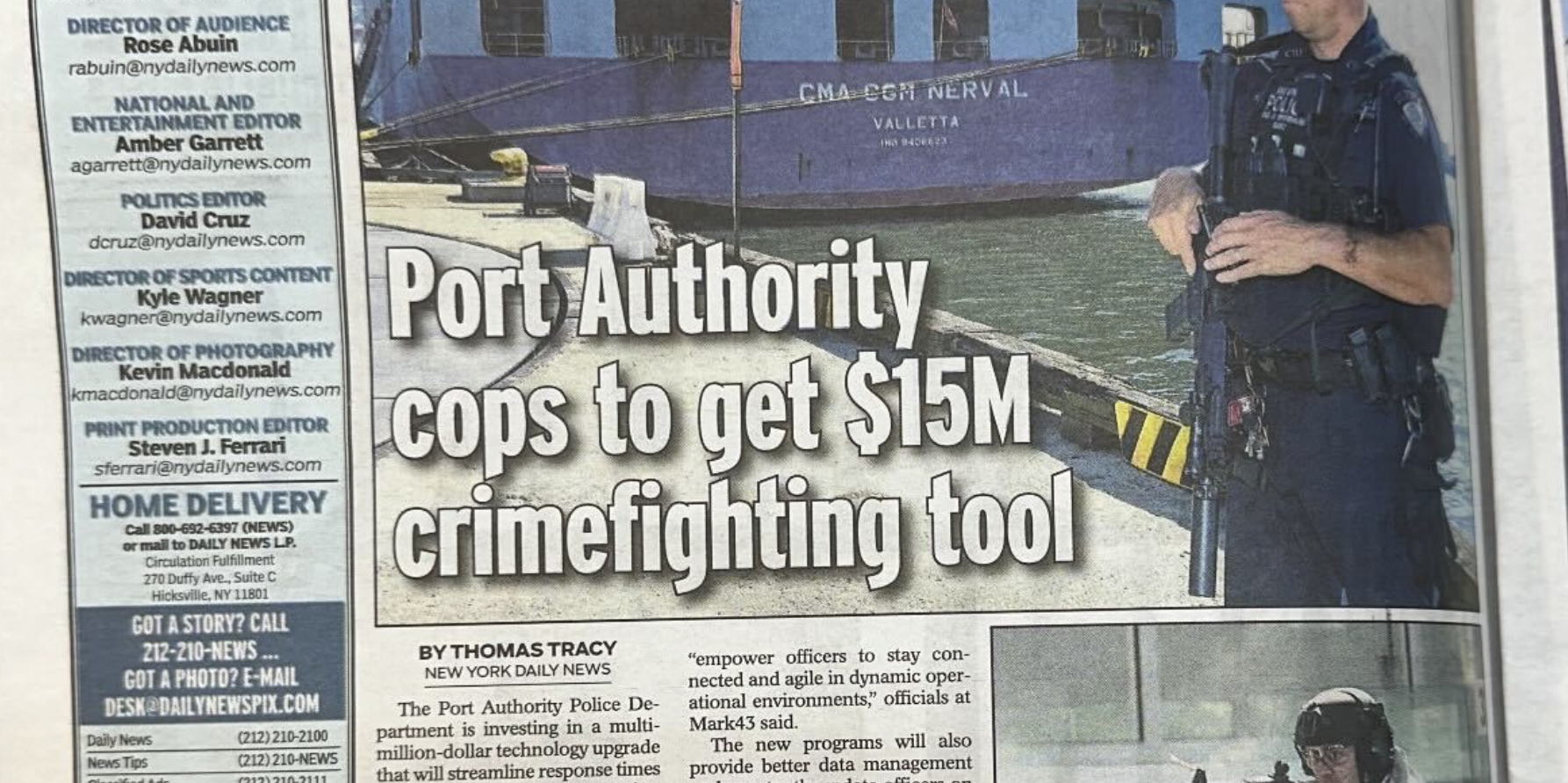
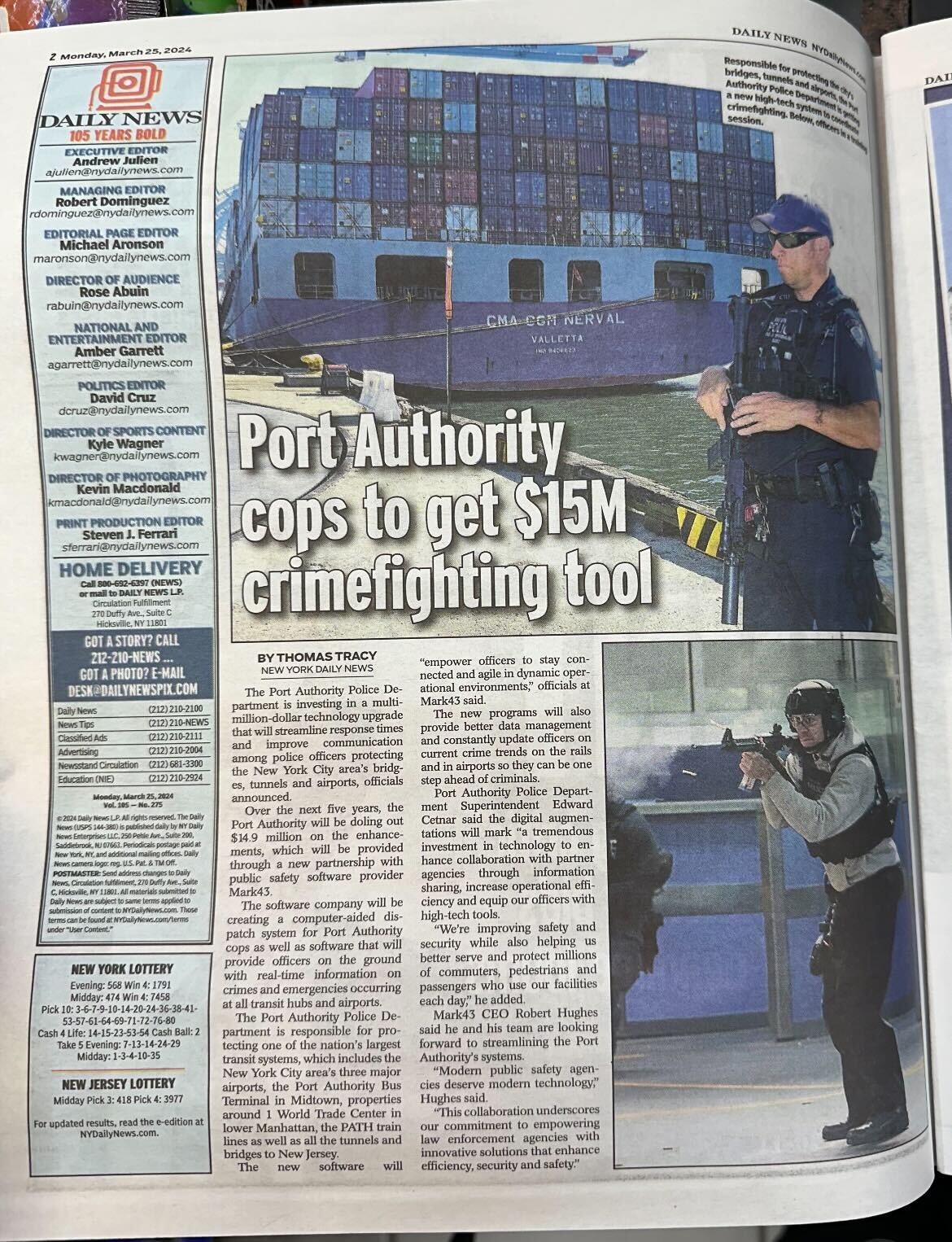
The Port Authority is set to make $15 million in upgrades to its police tech to increase response times and communication during critical incidents, putting it in line with other top police departments around the country.
The new tech will improve dispatch response times with a new interface and dispatching information pass back that will improve officer safety and situational awareness, according to Mark43, a private police-tech company awarded the contract.
The Port Authority Police Department has the largest transit-related police force in the country.
Port Authority police will have new tech that allows them to fill out reports from the field.Getty ImagesPort Authority Police are getting new tech to modernize their policing. Stephen Yang for NY Post
“The Port Authority Police Department is making a tremendous investment in technology to enhance collaboration with partner agencies through information sharing, increase operational efficiency, and equip our officers with high-tech tools,” Edward Cetnar, superintendent of the Port Authority Police Department, said in a statement.
“By leveraging innovative solutions, we are improving safety and security while also helping us better serve and protect millions of commuters, pedestrians, and passengers who use our facilities each day.”
PAPD will also be able to create a more efficient report-writing system where officers can write reports from the field to save time and increase accuracy, according to Mark43.
Another feature will be a new data analytics platform that will give insights into crime trends to inform resource allocation, according to Mark43.
Mark43 works with more than 250 local, state and federal public safety agencies to modernize policing across the country and typically takes a mobile-first approach to policing, the tech company said.
The Port Authority Police Department has the largest transit-related police force in the country.Anadolu via Getty ImagesPrivate police-tech company, Mark43, was awarded the contract. AFP via Getty Images
“It is an honor and privilege to serve the Port Authority of New York and New Jersey Police Department and work together to revolutionize the technology they use every day,” Bob Hughes, chief executive officer at Mark43, said in a statement.
“Modern public safety agencies deserve modern technology, and this collaboration underscores our commitment to empowering law enforcement agencies with innovative solutions that enhance efficiency, security, and safety. We value the importance of this partnership and are proud to leverage Mark43’s Public Safety Platform to support the Port Authority Police.”
NEW YORK — March 19, 2024 — Mark43, the leading cloud-native public safety software provider, is excited to announce a new partnership with the Port Authority of New York and New Jersey. This collaboration signifies a significant step forward in enhancing public safety operations and modernizing technology infrastructure within the nation’s busiest transportation hub.
The Port Authority Police Department (PAPD) serves as the largest transit-related police force in the country and is responsible for safeguarding millions of commuters, pedestrians, passengers, and visitors across a vast network of critical infrastructure. In addition to securing the Port Authority’s iconic bridges, tunnels, airports, and seaports, the PAPD is entrusted with the security of other essential properties, including three bus facilities (the Port Authority Bus Terminal, the George Washington Bridge Bus Station, and the Journal Square Transportation Center), the World Trade Center in Lower Manhattan, and the PATH train system.
PAPD will use Mark43’s FedRAMP High Authorized platform – the most resilient public safety platform on the market. FedRAMP High mandates 421 specific security controls, and this authorization ensures mature security protocols at every level. Mark43 FedRAMP systems also undergo rigorous audits by government-approved auditors at least once a year, ensuring transparency and accountability. In partnership with Mark43, below is an overview of the new technology coming to PAPD:
Cloud-Native Computer-Aided Dispatch (CAD): The implementation of Mark43’s modern, cloud-native CAD will enable the Port Authority to leverage intuitive user interfaces and powerful dispatching capabilities, empowering their first responders with enhanced situational awareness and improving officer safety. The software also supports faster response times and accurate location resolution supporting streamlined operations for the expansive Port Authority.
Comprehensive Records Management System (RMS): Mark43 will deploy its cutting-edge RMS tailored to the specific needs of the Port Authority. This advanced platform will streamline data management processes, improve information accessibility, and enhance operational efficiency, allowing officers to save time and focus on serving and protecting the public. Officers will be able to increase report-writing speed and accuracy, and rely on clean and timely data, all of which can help improve work performance and job satisfaction.
Mission-Critical Analytics Platform: Mark43’s analytics platform will provide the Port Authority with unparalleled insights into crime trends to inform resource allocation and operational decision-making. Law enforcement leaders will be equipped to optimize resource deployment and enhance overall public safety outcomes.
OnScene Mobility: Mark43’s OnScene mobility solution will equip Port Authority Police with real-time access to critical information and tools while in the field. This mobile application will enable seamless report filing, information retrieval and communication, empowering officers to stay connected and agile in dynamic operational environments.
“The Port Authority Police Department is making a tremendous investment in technology to enhance collaboration with partner agencies through information sharing, increase operational efficiency, and equip our officers with high-tech tools,” said Edward Cetnar, superintendent of the Port Authority Police Department. “By leveraging innovative solutions, we are improving safety and security while also helping us better serve and protect millions of commuters, pedestrians, and passengers who use our facilities each day.”
“The Port Authority is always seeking opportunities to employ new technology to deliver best-in-class service and results, including for public safety,” said Greg Ehrie, chief security officer of the Port Authority. “In this collaboration with Mark43, we are focused on providing our officers and employees with the tools they need to protect our facilities and customers across our jurisdiction.”
“It is an honor and privilege to serve the Port Authority of New York and New Jersey Police Department and work together to revolutionize the technology they use every day,” said Bob Hughes, chief executive officer at Mark43. “Modern public safety agencies deserve modern technology, and this collaboration underscores our commitment to empowering law enforcement agencies with innovative solutions that enhance efficiency, security, and safety. We value the importance of this partnership and are proud to leverage Mark43’s Public Safety Platform to support the Port Authority Police.”
Mark43’s commitment to innovation, reliability, and customer-centricity aligns seamlessly with the Port Authority Police Department’s mission to uphold safety and security within the Port Authority’s vast jurisdiction. Mark43 and PAPD are aligned in a shared mission to elevate the standards of excellence in public safety technology.
About Mark43
Mark43 is the leading cloud-native public safety technology company. By delivering modern, intuitive and mobile-first Records Management System, Computer-Aided Dispatch and Analytics platforms, Mark43 empowers governments and their communities to improve the safety and quality of life for all. Working with more than 250 local, state and federal public safety agencies, Mark43 is transforming how first responders use technology to respond, engage and serve the community. For more information or to request a demo, visit www.mark43.com.
The past decade has seen a meteoric rise in cloud adoption. A buzzword at the time, the cloud was treated with lots of skepticism, as many saw it as simply a data storage/access innovation.
While enterprises have been the loud, constant instigator of cloud spending, SMBs are beginning to turn skywards, with Amazon predicting that by 2025, 30% of SMBs will shift half of their key workloads to the cloud to drive business agility and future resilience.
In this article, we will explore the state of cloud security among SMBs, identify common cloud vulnerabilities and highlight cloud security best practices.
Key Takeaways
SMBs are rapidly adopting cloud computing but often overlook cloud security risks like misconfigured resources, insecure interfaces/APIs, and account hijacking.
Misconfiguration of cloud resources is a major risk exposure for SMBs, allowing threat actors to exploit vulnerabilities in the cloud environment.
Essential cloud security steps for SMBs include understanding their cloud environment, implementing multi-factor authentication (MFA), following secure practices from start to deployment, leveraging cloud provider security features, demanding better security standards from vendors, and implementing robust encryption.
Despite budget constraints, SMBs can leverage cost-effective security measures offered by cloud providers like AWS, Azure, and GCP to enhance their cloud security posture.
Investing in the right cybersecurity strategy is crucial for SMBs to protect their cloud investments and mitigate the significant financial impacts of data breaches
The SMB Cloud Security Landscape
Among companies with fewer than 500 employees, the average cost of a data breach, according to IMB, is approximately $3.31 million per incident. With more SMBs defaulting to cloud models, cybercriminals have redirected their radars on SMBs, a survey by Sophos has found. The survey indicated that 56% of respondents experienced an increase in the volume of attacks, 59% in complexity, and 53% in impact. The survey also noted misconfigured cloud services as the most significant cloud security risks for small businesses.
In addition to misconfigurations, Chris Doman, Co-Founder/CTO at Cado Security, told Techopedia that threat actors have become proficient in exploiting other issues such as insecure interfaces and API and poorly configured Identity and Access Management (IAM) credentials.
Doman said: “Insecure interfaces and APIs, such as the use of default credentials or open Docker APIs, Account hijacking, such as through phishing attacks for cloud credentials and misconfigured IAM credentials are common breaches in the cloud.”
While cloud providers have injected some improvements to forestall misconfiguration issues in the cloud, Doman believes that the other issues can’t be fixed by cloud providers, making them a serious challenge for SMBs.
“The good news is that the cloud providers have improved the default settings, making misconfigurations much more challenging. The bad news is that the other issues remain a problem, and the cloud providers will not solve them for you.”
Cloud Security for SMBs: 5 Essential Steps in 2024
Although SMBs face budgetary and resource constraints that make securing their cloud environments more challenging, there are still measures that can help strengthen defenses.
5. Understand Your Cloud Environment
The choice of cloud service provider should not just be based on cost and popularity. SMBs should commit to understanding the cloud environment of their preferred provider and ensure their core services align with the workload they intend to migrate to the cloud. They should also understand that cloud security is a shared responsibility between the service provider and their customers.
Shawn Loveland, Chief Operating Officer at Resecurity, agrees, saying that SMBs must “first understand their cloud environment and recognize that cloud security is a shared responsibility between them and their service providers.”
4. Prioritize MFA Implementation
Doman suggested that SMBs should implement multi-factor authentication MFA across their accounts as well as opt for IAM roles over IAM users to mitigate the risk of IAM credential misconfigurations. He also recommended some tools to auto-scale down IAM permissions.
Doman said:
“Enforcing MFA across all accounts helps prevent phishing attacks, and using IAM roles instead of IAM users helps prevent misconfigured IAM credentials. For example, tools such as AWS access advisor can scope down IAM permissions semi-automatically.
“Securing interfaces and APIs is a bit more complicated and can be done through API gateways and WAFs, using the cloud providers’ security tools to monitor and detect unusual behavior and scan your infrastructure for vulnerabilities.”
3. Start Secure and Remain Secure
Security leadership within SMBs needs to focus on making sure that continuous integration/continuous deployment (CI/CD) doesn’t turn into Continuous Vulnerability, said Fawaz Naser, CEO at Softlist.
“The basic principle is ‘Start Secure and Stay Secure’ during the whole cloud migration journey. Starting secure means making sure everything is properly hardened before launching and staying secure involves following good practices for managing changes and configurations.”
2. Leverage Cloud Provider Security Features
SMBs can also leverage cloud provider security features to boost cloud security. Major cloud service providers, such as Amazon Web Services (AWS), Microsoft Azure, and Google Cloud Platform (GCP), offer a wide range of built-in security features and tools designed to help organizations strengthen their cloud security posture.
So, instead of paying for a third-party security tool, SMBs can adopt relevant security features offered by their cloud service provider. This approach can help SMBs enhance their security capabilities without the need for extensive in-house expertise or additional investments.
For instance, AWS offers services like AWS Identity and Access Management (IAM) for granular access control, AWS CloudTrail for auditing and logging, and AWS Web Application Firewall (WAF) for protecting web applications from common web exploits.
Similarly, Azure provides Azure Security Center for unified security management and advanced threat protection, while GCP offers tools like Cloud Identity and Access Management (IAM) and Cloud Security Command Center.
1. Push for Better Standards
SMBs need to push their vendors for better standards in terms of encryption, best practices, and frameworks, Larry Zorio, Chief Information Security Officer at Mark43, told Techopedia via email.
“Users need to demand better standards, full stop. If you have the luxury of working for a company, push your vendors for strong encryption and other security best practices. Ensure they are following a framework. Ask for evidence like a SOC2 Audit, ISO Certification or FedRAMP Authorization.”
In addition, SMBs should implement robust encryption practices for data at rest and data in transit. Cloud service providers offer encryption services and tools, such as AWS Key Management Service (KMS), Azure Key Vault, and Google Cloud Key Management Service (Cloud KMS). These services can enable SMBs to generate, manage, and store encryption keys, ensuring that only authorized parties can access and decrypt sensitive data.
The Bottom Line
Understandably, the cloud is still a difficult path for many SMBs to tread. But as cloud adoption continues to soar and cyber attackers continue to bite, ensuring robust security measures is not an option but a necessity.
While limited financial and human resources could be a stumbling block to the effective implementation of cloud security measures for SMBs, some of the strategies outlined above are cost-effective and can be implemented at the SMB level.
In other words, it’s crucial to remember that investments in the right cybersecurity strategy are an investment to protect business investments.
A national survey of first responders shows major concerns with cybersecurity, disaster recovery, and information-technology resilience, according to Mark43, a leading cloud-native public safety software company.
Public safety professionals want technology upgrades and adoption of federal standards for first responder IT security, reporting, and efficiency, according to the 2024 U.S. Public Safety Trends Report released in December.
First responders “are concerned about their public safety agency’s ability to withstand cyberattacks and natural disasters, given the ever-increasing number and severity of bad actors attacking public infrastructure as well as the uptick in extreme weather incidents,” Mark43 Co-founder/President Matthew Polega said. “Public safety professionals made it clear they need access to modernized systems — like cloud-native CAD and RMS — to improve the security and resilience of their agencies so they can respond faster to community members in need.”
The report shows technology plays a central role in everything a public safety agency does. With Mark43 technology, police departments can improve the safety and quality of life for all, he said.
Data points from the survey illustrate most first responders’ concerns about cybersecurity, natural disasters, power grid failures, dispatch outages, and IT malfunctions, and their suggestions for improving IT resilience.
Many first responders have actually experienced cybersecurity attacks.
The ever-increasing number, severity and cost of cyberattacks is reflected in the concerns and experiences of first responders. Eighty-two percent worry their organization’s data could be stolen or fall victim to ransomware, a 6 percent increase over the 2023 U.S. Public Safety Trends survey, showing a need for enhanced security like cloud-based computer-aided dispatch (CAD) and records management systems (RMS).
A near-total majority (91 percent) of first responders have experienced cybersecurity-related issues in the past year, like phishing, scam calls, and malware attacks. Scam calls and malware/viruses are now the leading cybersecurity concern for first responders, overtaking phishing from last year’s survey.
A near-total majority (92 percent) of first responders are also somewhat or very concerned about how their agencies would handle a tactical response to cyberattacks or physical attacks at large-scale events like sports games, concerts, and conventions.
In January 2024, cyberattacks targeted the Bucks County (Pa.) Emergency Communications Department; the Securities and Exchange Commission in Washington, D.C.; and the city of Beckley, W. V., according to KonBriefing, an independent market research company in the IT field. KonBriefing reported hundreds of cyberattacks targeting colleges, municipalities, healthcare facilities, and government entities in 2023.
Other findings from the Mark43 report
Most first responders are very concerned about the impact of natural disasters and power grid failures on their agencies, with 84 percent reporting that such events can overwhelm public safety agencies and impact the service they deliver to their communities.
Alarmingly, 96 percent would be somewhat or very concerned if on-site mission-critical servers used in on-premises systems were located in the path of a hurricane or other significant weather event.
Real-Life Experience
Over two-thirds (67 percent) of first responders have experienced dispatch outages, and 88 percent have experienced other IT malfunctions. Eighty-four percent of first responders using computer-aided dispatch systems have experienced a CAD outage that impacted response times, including over a third (35 percent) who experience CAD outages six to 10 times per year.
Seventy-five percent of first responders reported that inefficient IT systems cause outages, delays, and other malfunctions. This is an increase of 8 percent over a similar survey last year.
Public safety professionals are calling for enhanced security standards to combat cyberattacks, IT outages, and malfunctions. First responders laid out solutions for the cybersecurity, disaster recovery and dispatch outage concerns and problems they report, including their top three:
More accurate reporting (52 percent), increased efficiency (51 percent) and increased data security (51 percent).
A near-total majority (93 percent) believe the general public would feel better if their local public safety agencies were required to adhere to federal cybersecurity standards, like FedRAMP, which mandates a premier and standardized approach to security and risk assessment for cloud technologies.
First responders and the general public agree on this issue, as nearly 80 percent of the general population respondents expressed support for local adoption of federal law-enforcement technology standards in a separate survey.
Using the expertise of emergency responders collected through the survey, insight from Mark43 customers, and input from leading luminaries in law enforcement, the Mark43 2024 U.S. Public Safety Trends report identifies the below emerging six trends that will impact public safety in 2024 and beyond. You can order the full report here.
The Trends
Artificial Intelligence is here to stay
Modern technology is a solution to the recruitment and retention crisis
Technology systems must be resilient and secure
Mobility is not the future, it’s the now
Breaking data out of silos is critical for facilitating community trust and multi-agency coordination
Gun violence still requires a relentless focus and modern technology is a critical component
“As we approach 2024, first responders expect public safety agencies to use modern technology solutions that are resilient and reliable so they can focus on keeping their communities safe,” Polega said. “In 2024, we will see leading public safety agencies prioritize security and resilience to support critical decision-making, better allocate resources, and ultimately, serve their communities even more effectively.”
The national online survey of 349 first responders was conducted by Propeller Insights between Oct. 3 and Oct. 18, 2023. Respondents opted into an online database; from there, they were targeted based on demographics.
NEW YORK – January 25, 2024 – The Surprise Police Department in Arizona is significantly upgrading its technology portfolio by partnering with Mark43, the leading cloud-native public safety software provider. Surprise PD will now have Mark43’s computer-aided dispatch (CAD), records management system (RMS), and analytics suite, providing its 190 sworn officers and 30 telecommunicators with an intuitive platform that will enhance the effectiveness of first responders, improve investigations, streamline operations and support the safety of the entire community.
Benny Piña, Chief of the Surprise Police Department said, “Partnering with Mark43 is a game-changer for the men and women of the Surprise PD, who deserve the best technology. What sets Mark43 apart is not just the seamless access to crucial information in real time; it is the unparalleled customer service and support. We’ve found a genuine partner in Mark43.”
Matt Polega, Mark43 Co-founder and President said, “We are proud to launch this partnership with the Surprise Police Department to support its officers and telecommunicators as they work to keep Surprise safe. CAD and RMS are the backbone of any police department, and the Mark43 Public Safety Platform will help Surprise PD in its tireless efforts to keep community members safe.”
The Surprise PD will transition from a legacy, on-premises system to Mark43’s cloud-native CAD, RMS and analytics suite which delivers the most secure and resilient solution available.
The technology that powers Mark43 RMS will assist officers and staff by enabling faster report-writing, better case management, and enhancing work performance and job satisfaction. It will act as a force multiplier by cutting administrative tasks and letting officers spend more time out in the field with the community.
In addition, Mark43 CAD operates as a natural extension of the dispatcher, call taker, and in-field first responder during emergency response. Surprise telecommunicators will use the system’s functionality to pinpoint exact caller/responder locations and share critical, life-saving data with all nearby responding units to enhance safety for emergency responders and ensure increased situational awareness when responders arrive at calls.
The Surprise PD is also deploying Mark43 OnScene, an on-the-go app that extends an agency’s computer-aided dispatch (CAD) deeper into the field by putting mission-critical CAD information into a first responder’s hands via their mobile devices, even while away from their vehicle.
Chief Piña added: “Mark43 OnScene will be a recruitment boon. Offering recruits the same quality tech that they use in their daily lives, accessible on their phones, is a real win for us.”
Mark43 continues to partner with police departments across Arizona, with Surprise PD joining the Scottsdale Police Department and the Apache Junction Police Department.
About Mark43
Mark43 is the leading cloud-native public safety technology company. By delivering a modern, intuitive and mobile-first Records Management System, Computer-Aided Dispatch and Analytics platform, Mark43 empowers governments and their communities to improve the safety and quality of life for all. Working with more than 250 local, state and federal public safety agencies, Mark43 is transforming how first responders use technology to respond, engage and serve the community. Mark43 provides the tools, resources, expertise, and security foundation that public safety needs today, tomorrow, and beyond. For more information or to request a demo, visit www.mark43.com.