



At Mark43, innovation is at the heart of how we work.
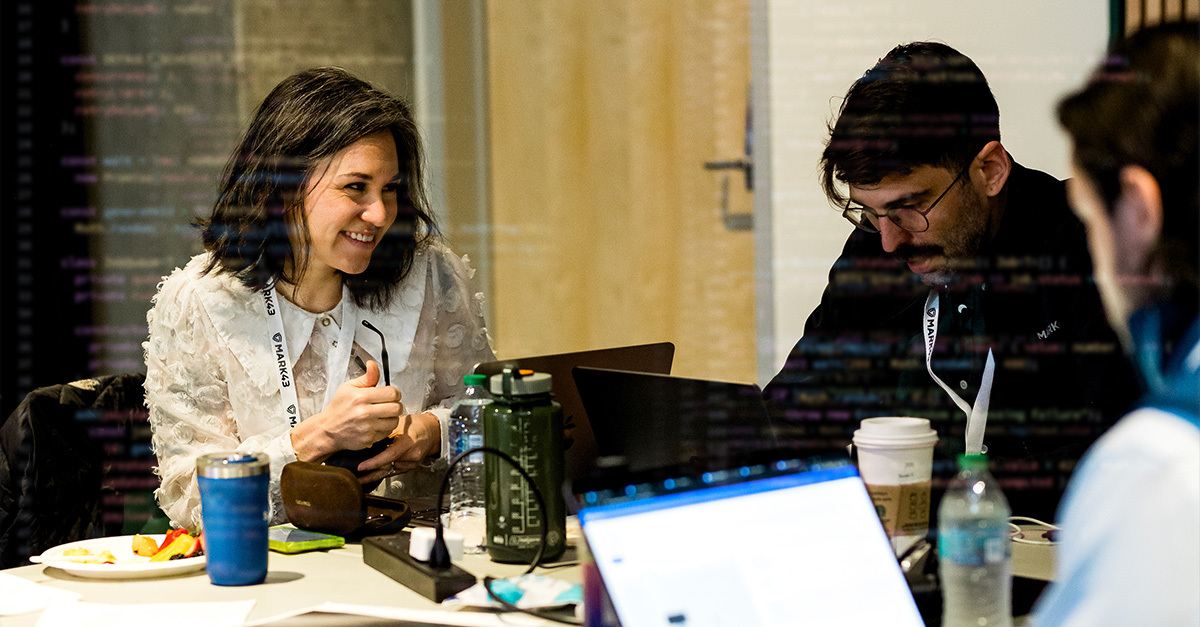
Throughout the year, that commitment is on display in our company-wide hackathons. Employees from across the business step away from their day-to-day work, form cross-functional teams, and build new concepts to improve our products and operations.
This spring, 37 participants pitched 24 ideas and built 15 live demos. The result showcased what happens when engineers, product managers, designers, customer experience experts are given space to experiment, collaborate, and move quickly.
“Hackathons create space for rapid experimentation outside normal roadmaps, allowing teams to explore ideas that might otherwise not surface,” said PJ Ricciardi, Director of Support at Mark43. “They act as a proving ground for innovation, where strong ideas can quickly evolve into prototypes that influence longer-term product strategy.”
Space to Experiment
Hackathons create something essential: protected time to explore ideas outside the roadmap.
“Hackathons give every employee explicit permission, twice a year, to set down the roadmap and chase the idea they think will most move the needle for our customers. That signal of trust matters as much as any individual project that ships,” said George Cornell, SVP of Engineering at Mark43.
In 48 hours, teams compressed the distance between “I have an idea” and “here’s a working demo.” That speed helps Mark43 learn faster, test what is possible, and evaluate ideas through something tangible instead of theoretical.
“Because every submission is a working prototype, the ideas are dramatically easier to evaluate and act on,” said Ravi Maira, VP of Product Marketing and Enablement at Mark43. “We’re not debating slideware. We’re looking at something real, which makes it much faster to decide what deserves a next step.”
Teams Built Across Disciplines
Innovation at Mark43 is strongest when many perspectives are part of the process. Great ideas can come from anywhere.
This year’s projects brought together technical expertise, customer understanding, product strategy, and operational insight to move quickly with a focus on the frontline users.
“Hackathons surface ideas from across the entire company, not just the official channels of product management and customer requests,” said Maira. “Some of our best thinking comes from engineers, designers, services and support teams and other teammates who see problems from angles the formal roadmap process can miss.”
It also broadens where innovation begins. Some ideas focused on product use. Others tackled internal challenges to help Mark43 deliver faster. Together, they reflected a culture where innovation is owned by everyone.
That collaboration is one of the lasting benefits of the hackathon. The relationships, shared context, and trust built during the event continue long after demo day.
A Shared Focus on AI for Solving Real Problems
This year’s judging criteria focused on creativity, craftsmanship, technical complexity, viability, and customer value.
“We look for clear customer impact, simplicity of execution, and the ability to realistically scale beyond the hackathon. Strong projects tend to deeply understand a real user problem and solve it in an intuitive, efficient way,” said Charley Dublin, SVP of Service & Delivery at Mark43.
That problem-first mindset showed up across the winning ideas.
Next-gen AI tools helped teams build faster and think bigger by streamlining critical workflows, surfacing information faster, reducing manual effort and improving access to knowledge across the organization. Some projects focused on enhancing product capabilities for end users, while others examined ways to accelerate internal processes and strengthen collaboration.
Teams used AI as an applied problem-solving layer with agents that searched source repositories, reconstructed likely UI flows, generated confidence-scored outputs, created semantic search experiences, and turned natural-language inputs into actionable workflows, paired with human expertise and validation.
For example, one prototype was built to make Mark43’s systems instantly understandable across the organization, helping Product, Sales, Customer Experience, and new hires get clearer answers without digging through scattered documentation or relying on secondhand knowledge. Another mapped out a faster way to create visuals for suspects while a search is still underway.
“What stood out this year was how many teams focused on practical, high-leverage AI rather than AI for its own sake,” said Cornell. “The strongest projects built agentic AI directly into real workflows, helping reduce friction and make knowledge or decision support more accessible. The surprise was the velocity. AI tooling helped small teams ship in 48 hours what could have taken a quarter of work a year ago. That’s a leading indicator of where our shipping pace is headed.”
From Prototype to Real-World Impact
Mark43 hackathon projects have historically influenced the product roadmap, and several of this year’s winning ideas are already being explored.
“Our customers are the experts in public safety, and they bring deep insight into what technology needs to do in the field,” said Maira. “Our job is to build it. Hackathons are one of the ways we make sure the pace of innovation we bring them keeps up with what’s possible.”
Cornell added, “Public safety has historically been under-innovated by software vendors. Every hackathon project, win or lose, is a small step toward closing the gap between what officers and analysts deal with on duty and what modern software can do for them.”
At Mark43, innovation is an everyday practice in how teams collaborate, how ideas are tested, and how promising concepts move from prototype to products being used by public safety professionals in the field.
Explore open roles today.