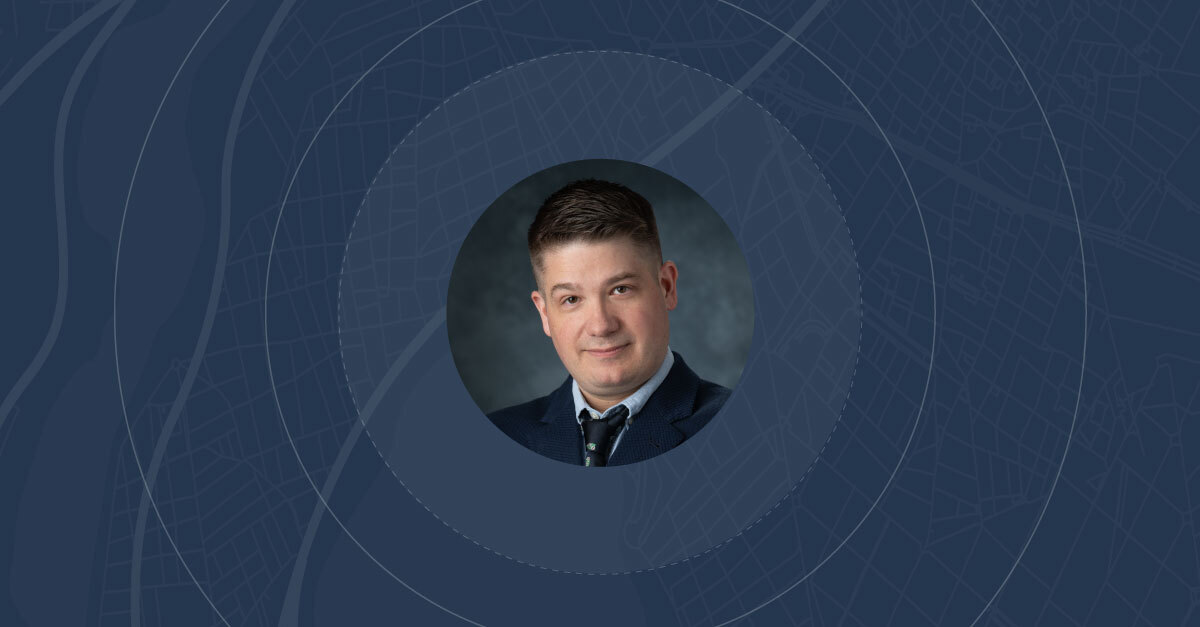

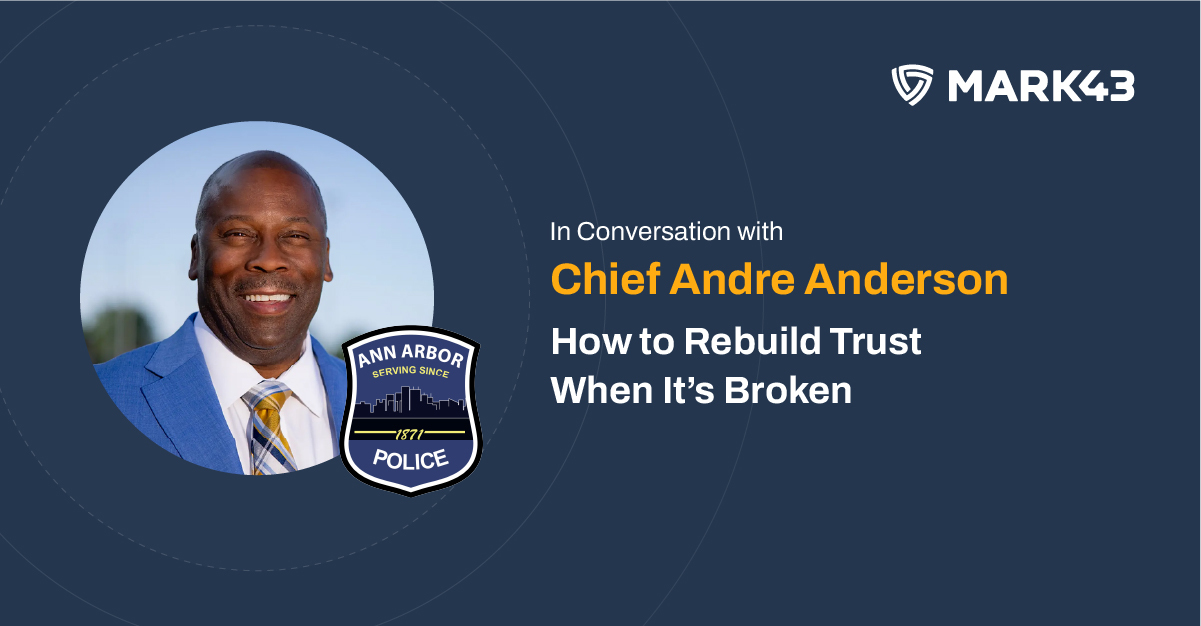
Chief Andre Anderson on Leading Through Fracture
What does trust repair actually require and who needs to be in the room? Chief Andre Anderson has led departments in Ferguson, Missouri and Rochester, New York, two of the hardest environments in American policing. He has seen firsthand what happens when relationships between police and communities fracture and what it takes to repair them. In this conversation, he talks about what those experiences taught him, how civilian oversight can become an asset rather than an obstacle, and why the work of rebuilding trust has to start inside the department.
You’ve led in communities where trust between police and residents has broken down significantly. What does rebuilding that actually require?
First, you have to find the quality, community-oriented officers already in your organization and give them room to show who they are. When you get a good police officer in front of the community — someone with genuine concern for people — that’s the first step. The community can see it. It’s not performative.
The second thing: you have to really, honestly care about people. And this is not something you can learn, or a strategy, or something you can be trained to do. It has to be part of who you are. So as you hire, as you build your leadership team, you’re looking for people with that integrity and genuine concern — and then you get them in front of the community.
What about community members who are angry or who don’t trust the department at all? How do you reach them?
You find the community members who have a genuine drive to make things better — even if their passion looks like opposition. They can have angst, they can be upset, and they may have very good reason for it. Your job is to understand where that passion comes from and listen with a problem-solving lens.
In Ferguson, I focused on mothers, grandmothers, and pastors because they were already trusted voices in the community. If we wanted to rebuild trust, we couldn’t start by asking people to trust the police. We had to work through people the community already trusted.
A community that is 67% African American, you have to understand that community to build trust. I knew those three groups had credibility. When officers started demonstrating that they were there to help grandmothers, that they would listen to mothers, those relationships helped us build trust in ways that policies alone couldn’t.
We also met with protest groups. Sometimes people protest for the right reasons. Understanding what those reasons are matters. We used community members themselves to help de-escalate tensions. The humility in allowing the community to be part of the solution is what actually builds the relationship.
Ann Arbor has a civilian oversight commission, ICPOC. The relationship was fractured when you arrived. How did you turn that around?
The first thing I had to do was recognize the role of an oversight commission. Their role is not to be your friend. Their role is not to agree with everything the police department does. Their role is to hold the department accountable and to help develop policies that reflect what the community actually needs.
Once I accepted that, we got to work. The breakthrough came when we stopped treating oversight as something happening to the department and started treating it as something we were building together.
We wrote policies together around how officers initiate contact with community members, requiring officers to explain the reason for a traffic stop at the outset. We worked on de-escalation, and more importantly, pre-de-escalation: the mindset and approach that means you’re less likely to end up in a situation requiring force in the first place.
We also brought trauma-informed policing into the conversation with them. Many officers carry their own trauma. Many community members have been traumatized by prior encounters with police. Recognizing that in policy and practice changes how those interactions go.
The relationship with ICPOC is exceptional now. Not because they agree with everything we do but because we’ve built something real together.
What’s your message to chiefs who see oversight as adversarial?
If you see it as adversarial, you’ve already lost the opportunity. The oversight commission represents voices you need to hear. Engage them early, involve them in policy development, and be honest when you don’t have the answers. That’s not weakness. That’s how you build the kind of accountability that actually holds up over time.
Trust, Chief Anderson says, isn’t something you can engineer. But you can create the conditions for it. That work starts long before a crisis. In part three, he talks about how data can either reinforce old assumptions or help departments ask entirely different questions.
Chief Andre Anderson is the Chief of Police for the Ann Arbor Police Department. He is a longtime member and leader within NOBLE (National Organization of Black Law Enforcement Executives). Mark43 is a proud sponsor of NOBLE.